Expert Engagement
How Design News turned to its community for content. by Michael Rondon
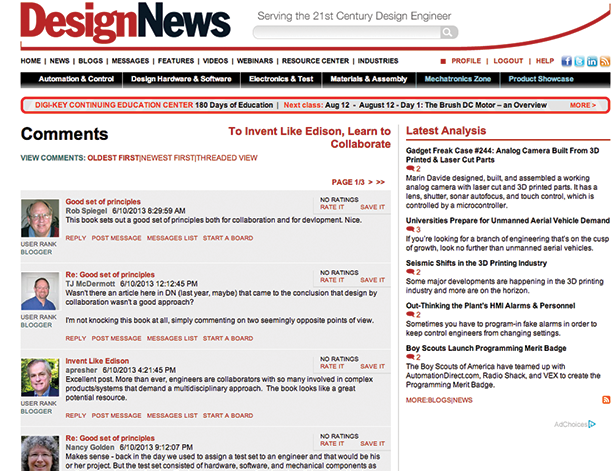
Design News gets more than 4,000 comments per month on its website. That’s about one for every five registered users.
Design News gets more than 4,000 comments per month on its website. That’s about one for every five registered users.
Traffic was dwindling, engagement was nonexistent and Design News was about to be shut down in July 2011.
A month later, the momentum had changed and its metrics were up across the board.
Design News, a design engineering brand produced by UBM Tech, relaunched in mid-summer of that year, but there wasn’t a radical redesign or marketing push—just some tweaking.
The site migrated to the community-oriented UBM DeusM platform under the guidance of Stephen Saunders, managing director of UBM DeusM. Switching the site’s focus from editorially-driven to user-generated content underpinned the effort.
UGC made up less than a tenth of the total number of articles on the site at the time, Saunders says, but close to 40 percent of the Design News’ traffic was coming from it. Readers wanted to hear from industry experts directly. Design News had tapped a vein, but didn’t know it.
“A lot of the traffic really wasn’t coming from the articles being written by the reporters and editors,” he says. “It was actually coming from a handful of relatively inexpensive user-generated content features on the site. Some of the stories that were being published as news were actually pushing people away from the site. When people would come in, if the first thing they saw was a low-value news story, they wouldn’t come back. It was having an effect on repeat traffic.”
Now, more than 50 percent of the site’s content is user generated. Readers responded immediately when the change took place.
Engagement spiked at the relaunch. Monthly page views doubled, topping 600,000; pages per visit went from 1.2 to 1.8; message board posts tripled to more than 1,000. All with minimal promotion, Saunders says.
Editorial roles needed to shift along with the content makeup though. Saunders reduced the staff size by about half and significantly changed the department’s day-to-day operations.
Editors still provide news content, but now they’re responsible for driving conversations about those stories and managing related message boards. They’re tracked individually and the best are given bonuses, while missed quotas trigger performance reviews.
“It’s almost like a sales model of accountability: You reward the best and get rid of the worst,” he says. “They all see each other’s numbers, so there’s no [secrecy]. If somebody’s doing really badly, everyone else knows about it. And that creates its own pressure. Editors don’t really like it very much, but it’s been quite effective.”
Online Learning: An Engagement Wellspring
Engagement rose again with the introduction of a learning product in early 2012. Comments quadrupled, with the site now averaging more than 4,000 posts per month.
The Digi-Key Continuing Education Center provides an audio stream and a live instant messaging board for registrants. Sessions regularly generate between 200 and 500 comments as questions are posed to the featured speaker and to the rest of the room. Saunders says more than half of the attendees participate in the discussion.
“Online learning is about the hottest thing that you can put on a website right now,” he says. “These universities, when we launch them, create these massive traffic spikes. That’s been almost universal. It’s the combination of high-value proprietary information with a learning environment like an online university, plus a message board so the students can talk to each other.”
Fundamentally, a Digi-Key education session is the same as a webinar (which Design News still does offer separate from the education center). They’ve just removed a passive element—slides—and added an interactive one—live chatting. A PowerPoint presentation is available, Saunders says, but no one downloads it. They learn more through discussion.
Like the shift in content strategy, it’s a small, but significant change.
“So often, it’s something incredibly simple, or a twist on something which already exists, that’s actually the secret to success on the Internet,” Saunders says. “I think the audience now wants to talk to each other and want to talk to the editors. All you have to do is turn it on.” 