AskMen Answers on Segmenting a Large Audience
Segmented audiences can enhance engagement and increase the value of data. by Caysey Welton
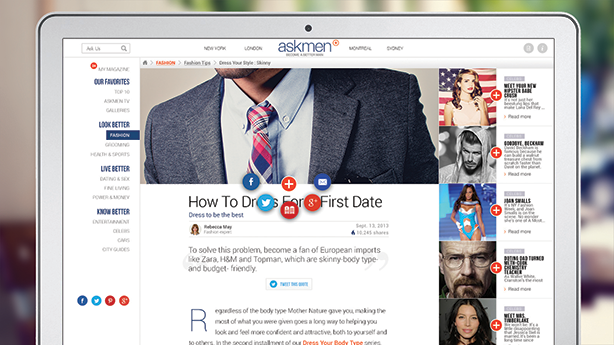
AskMen is launching a suite of updated digital products on August 29 that will include a responsive design website.

AskMen is launching a suite of updated digital products on August 29 that will include a responsive design website.
Maintaining a space that discreetly identifies with 17 million unique monthly readers is a fundamental objective for AskMen. And meeting that goal is key to the company’s strategy for boosting engagement and increasing revenues.
Ryan Johnson, AskMen’s director of marketing and business development, says traffic volume is most important since 85 to 90 percent of the company’s revenues come from display advertising. But to keep readers on page longer, ensure return visits and grow ancillary income, Johnson says that it is imperative to “capture the audience within the audience.”
“For the longest time a website audience was seen as monolithic,” he says. “You could look at a site like AskMen.com and justifiably say that it’s an audience of men between 18 and 34 with ‘X’-amount of disposable income and ‘X’-percent have management positions, but it doesn’t really tell the whole story.”
AskMen segments its audience by content interests, leveraging them to aggregate data, generate leads and target-market products.
Johnson points to the site’s Watch Snob column as an example of how the company has done exactly that.
Last year, AskMen put an email capture at the bottom of its Watch Snob articles to create a silo of registrants. The company also had a watch deal that it marketed to a master list of more than 1 million. The response rate of Watch Snob registrants performed exceptionally well in comparison.
The acquisition rate of Watch Snob readers who provided their email address was 15 percent. And of those 4,627 readers, 47 percent opened the watch-specific marketing test email.
“What we’re really trying to do is ramp up our commerce activities, and this showed us that we need to segment our huge audience to get them more engaged and drive revenue,” Johnson says.
Making it Happen
AskMen’s strategy didn’t develop overnight, however.
“A year ago we were a site with a buying list,” Johnson says. “We tried briefly to move into the deal space, but it’s a hard road. You put some offers out there that you think are going to work and they don’t, they fall flat on their face. But where AskMen adds value, as a publisher, is that it creates context. What that means is we offer a ‘why’ for a purchase decision.”
Johnson says the strategy took a full pivot when the company recognized the value of its lists and its audience engagement. Still, AskMen didn’t want to approach its audience with the same predictable strategies that many rely on, which typically offer predictable returns.
“Let’s create emails and design them around themes. Let’s make them very tight. Let’s make big beautiful evocative images. And let’s throw surprises in there rather than just a bunch of commerce stuff,” Johnson says. “Let’s get crazy deals in there that capture peoples’ attention. That’s what people want, that’s why they engage.”
Most of the leads AskMen generates are shared with clients and affiliates. Johnson suggests that the company is looking to get away from one-off transactions and is aggressively pursuing ways to make its readers a sustainable revenue source.
In other words, AskMen is not interested in leading an anonymous reader to a commerce site where he or she can make a one-time purchase. Instead, the idea is to market to each lead as an individual and provide them with bespoke product options. Johnson believes this tactic is key to sustainable revenue.
“We have a sense that we are not just driving them to one purchase but rather multiple purchases over a month,” he says. “That gives the merchant more visibility in terms of the audience we are driving to their site, which means more money for us because they understand our full value.”
Social media is another area that the site is looking to leverage further. Still, Johnson calls social “a tough nut to crack” for a website that generates 65 percent of its traffic through search and emphasizes the importance of SEO. Nevertheless, AskMen is investigating new ways for social to aid in its commerce efforts.
Specifically, Johnson sees potential with Pinterest—despite its largely female demographic. “Pinterest is pro-commerce in the way it’s structured, so were working a little bit more with it these days even though our social profile is larger elsewhere,” he says.