A Conversation With the FOLIO: 100
Emerging media trends from the perspective of some of our industry’s influencers.
BY MICHAEL RONDON
A Conversation With the FOLIO: 100
Emerging media trends from the perspective of some of our industry’s influencers.
BY MICHAEL RONDON
A Conversation With the FOLIO: 100
Emerging media trends from the perspective of some of our industry’s influencers.
BY MICHAEL RONDON
"We’ve seen success treating our audience as collaborators, and co-creators, and that’s allowing us to engage and support the development of the content itself."
—Elizabeth Burnham Murphy
"We’ve seen success treating our audience as collaborators, and co-creators, and that’s allowing us to engage and support the development of the content itself."
—Elizabeth Burnham Murphy
"Digital media is powerful, but it’s also created this huge glut of concept. It’s hard for serious high-quality content to stand out digitally."
— Lynda Hammes
"Digital media is powerful, but it’s also created this huge glut of concept. It’s hard for serious high-quality content to stand out digitally."
— Lynda Hammes
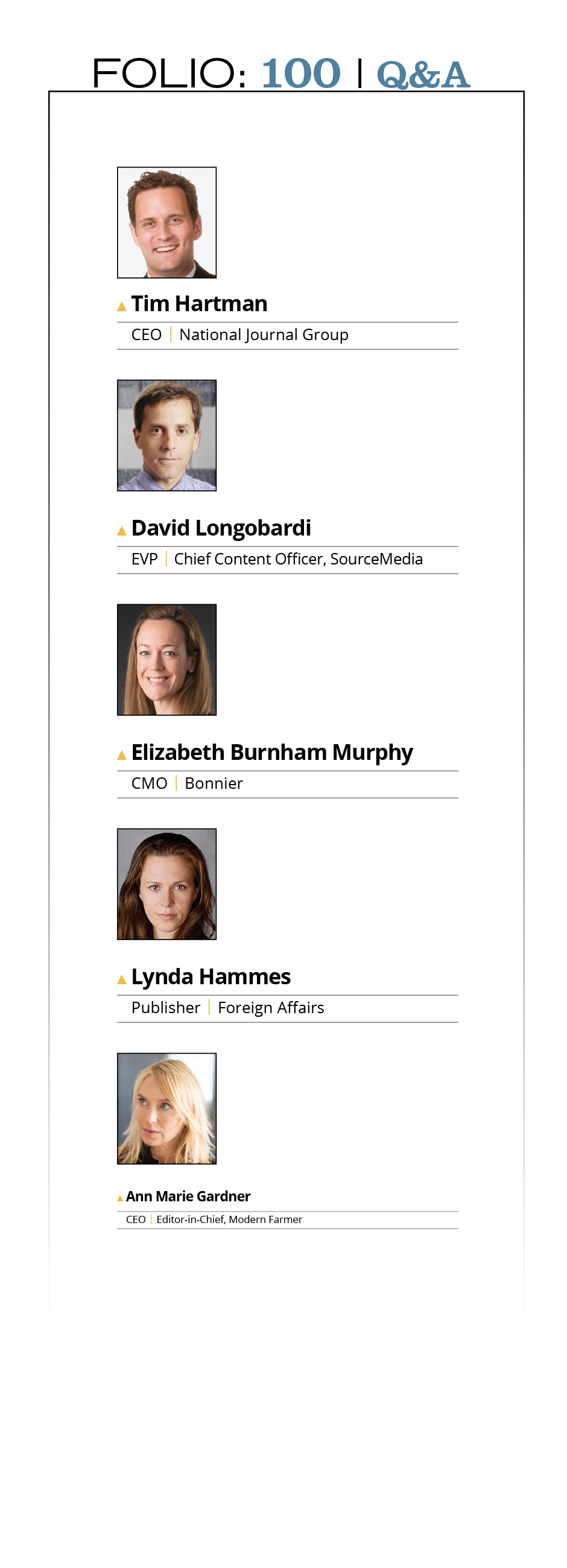
The FOLIO: 100 brings together individuals in publishing from across all markets and mediums. With representatives from mass consumer titles on the cutting edge of digital, to those at niche B2B magazines thriving on print, it’s clear there’s no one way to define success.
Here, we’ve brought together a cross section of the FOLIO: 100 to delve into issues like the viability of print, what engagement really means and other emerging trends that’ll shape publishing in the coming years.
 What’s the trend you’re looking at that’s gone under-reported so far? And how does that play into your brand’s immediate plans?
Tim Hartman: News organizations are becoming more user-oriented. It’s really is a concept of using journalism as a service to help people get things done. So at National Journal we do it in a couple of ways. Our mission is to be the most trusted source for anyone looking to understand and navigate Washington, D.C. And, we have a membership business that serves our readers through journalism, tools and research that can be tailored to help any member navigate Washington.
David Longobardi: One aspect of that approach is of particular interest to us. Clearly, understanding users is fundamental, but I think one of the things we see a lot of opportunity in is this idea that a news organization can become a research organization. We’ve brought on a small group of people who are very expert at conducting different types of research, and that capability sits alongside our core editorial division. It provides a really powerful bridge between the fundamentals and what makes us a great media brand—this intense customer loyalty and these terrific databases of extraordinarily qualified people with high response rates.
The entity sits between editorial and marketing and sales and derives strength from the subject matter expertise that is in the editorial group, while enabling the editorial group to conduct editorial research and the marketing group to focus on client research.
Research has been a part of B2B publishing for a while, at least in some capacity. Is that an approach that can work for consumer brands as well? Should they be developing research products?
DL: Consumer research is a fairly commoditized service or product, but when you think about B2B research and about the market place—with analysis firms and big research behemoths—you have an opportunity as a B2B brand to take advantage of the power of your database and the power of your brand in a way that is extremely distinctive.
If you’re willing to invest, modestly, in an advanced research capability, then you can really boost yourself up to a place where what you’re offering might even be unique in the true sense of that world. I think it’s very different than consumer, in that regard. There’s a lot of strength you can draw from your brand and your database within B2B.
Elizabeth Burnham Murphy: We’re certainly looking at research and data for product development in a much different way than we have been. One of the trends we’re noticing is that there’s a larger appetite for niche brands to go even more niche. Brands are hungry for even more information in their passion areas, so we’re focusing a good deal of analysis and product development on that—not only for our audience, but also for our advertising partners.
Take Saveur, for instance, which launched a new SIP, Drink, that we’re going to do a handful of times a year. It’s only targeted towards the audience that we segmented and selected based on their habits and interests in that category. This brings us a very highly selected audience for our advertisers. It’s been really successful.
TH: It comes down to which users are really engaged with your brand—they’ll tell you things that they won’t tell other people. For us, we found we had a large audience in the defense community, but we weren’t serving them directly.
So we actually saw an opportunity to launch a brand serving that audience, and we started Defense One last year. We had tremendous confidence in serving that audience because we heard directly from them that there was this gap in the market. That’s where the user approach can be really powerful.
Before you measure your communities, you have to engage them with content. That takes a lot of forms now besides standard text-based articles though. Where have you seen the most success in engagement beyond the traditional routes?
Lynda Hammes: Events. We all have great customer loyalty and passion, and I say on top of that, what Foreign Affairs can bring is competing power. Between the high-level authors we have and the demographic of our readers, we’re bringing together a really amazing, unique conversation in real life with these events.
There’s obviously an opportunity to add high-quality video content to that because of the nature of the event itself, but there’s also this service element that we’ve been talking about, and that’s the opportunity to network. Not just networking with people in your same space, but we bring up an international audience to meet with investors based in New York, so they can make spontaneous discoveries with one another. Much like our magazine is a hybrid consumer and trade audience, our conferences are meeting a trade audience’s needs through conferences, and a consumer audience’s needs through entertaining evening-style events.
Ann Marie Gardner: I agree in that events are that really physical component where the reader can engage with you, but, we’ve taken events to a different level. We believe that events can happen digitally, so we do events online. Whenever our print magazine comes out, if it has a goat on it or a lamb on it, we combine that sale date with a whole week where we’ll do all our content around that cover, that animal. We get a substantial amount of our traffic for the month just from that week. Not only that, but it drives our subscriptions, and it marries the print and the digital in a really great way. We’ll be moving towards physical events this year to complete that triangle.
EBM: We’ve seen success treating our audience as collaborators, and co-creators, and that’s allowing us to engage and support the development of the content itself. For instance, Field & Stream has a fantastic tool on its site called the “Answers Tool” and it allows the audience to engage with editors and then with each other. And sometimes this tool can deliver up to thirty percent or more of our traffic. So, it’s allowing that community to evolve, giving them the space and template to interact with each other, and it’s helping us to build our content and direct our message as well.
DL: Another category that’s been very important to us, and has really challenged us, is rich media. We have very high-end audiences, often exclusively senior management in our verticals, and one of the things that has challenged us is rich media because we have this challenge of wanting to create a frothy, pageview-rich environment with lots of traffic for an advertising community.
On the one hand we want to avoid the traps of just throwing video up there because it looks good and just doing slideshows because they’re clickbait. One of the rubrics we’re operating under here is ways to do smarter, rich media: How to do slideshows or galleries that are actually offering structured content in a way that is smart and useful, while also, importantly, offering any user the ability to opt out of that content in a single page format. Similarly with video, we’re looking for ways to bring higher utility to that medium.
Everything we’ve talked about—digital strategies, live events, research, etc.—for the majority of publishers, you can combine it all and it doesn’t add up to close to what print provides from a revenue standpoint. There’s no question the investments are going into those ancillary products though. Where does that leave print?
TH: Our users are still heavily engaged in print and that guides everything that we do. People value the long-form stories that we tell in our magazines. And our users, many of whom are on Capitol Hill, they’ll use National Journal Daily, our national print publication, as a way to guide their day. As long as we have that usage and relevance, print will still be a healthy part of our business.
DL: We’re in a transitional phase. That’s stating the obvious, but print is a diminishing portion of our business. We have more digital revenues than we do print revenues, and that’s significant to us, that’s an important metric. We believe that digital is a much more powerful medium to achieve our content delivery goals and our goals with respect to our audiences, free and paid, and our goals with respect to our marketing clients, without question.
It’s still a part of what we do however, so we try to operate as much as possible on a digital-first basis, while trying to reduce the effort and resources that we apply to print while maintaining its quality at an appropriate level. And print is still an important leg in selling a big event, an integrated program. If you want to go out with a terrific Web presentation, terrific social media components, a live event, print rounds out that package and it does still help drive revenue.
LH: Absolutely. A lot of people still revel in the glory of the printed page, and it’s not just our readers—it’s advertisers who continue to see the power and potential of print partly because of how much time our readers spend with each issue.
And, at least with our audience, there’s still this aura of gravitas towards the printed page. Digital media is powerful and technology has made this great contribution to the world by democratizing publishing, but it’s also created this huge glut of concept. It’s hard for serious high-quality content to stand out digitally.
Print is still quite important to us, and I’d say traditional brands and magazines still need to continue to rethink things with continued reductions in frequency, turning magazines into more of a luxury, coffee-table kind of thing. And you have to rethink the strategy around that, but it’s still completely relevant.
AMG: We launched with a print product because if you’re a premium niche brand you’ve got to have a print product. It explains why Porter was launched this year. Net-a-Porter has always been a merchandising site, but their audience almost demanded a print product to go with it.
So with Modern Farmer we launched with a print product and it’s sort of a disproportionate amount of our revenue right now, but that will catch up. And because we launched quarterly we don’t expect to change our printing schedule. Quarterly has worked really well and it’s become an adjunct to all the other platforms we have, which we’ll continue to expand into merchandising and digital.
Our print product was launched with that idea that it’s almost a luxury coffee table book for people, and it’s a gift, so I don’t want to say it’s a loss leader because right now the revenues are almost eighty percent. But, we’ll be very quickly switching into larger partnerships and we won’t be so dependent on print. It was always our business plan to launch with print as a sort of short- to medium-term leader, driving the content. And it’s helped so much to build up our brand. I’m all for print I think it will still be here.
EBM: I would round that out to say we’re going to continue to evolve and hope to serve our audience in the multiple media channels we’re going to be in, but print is going to remain critically important for years. Our challenge, and probably our greatest opportunity, as an industry and a company, is to continue to keep that print product at a high-quality level and at the same time pivot and innovate. Digitally and in our developmental businesses, we have to keep pace with this rapidly changing digital space and with audience demand. 