Rx for RDA
The Company is poised for a rebound with the return of Bonnie Kintzer.
Rx for RDA
The Company is poised for a rebound with the return of Bonnie Kintzer.
Rx for RDA
The Company is poised for a rebound with the return of Bonnie Kintzer.

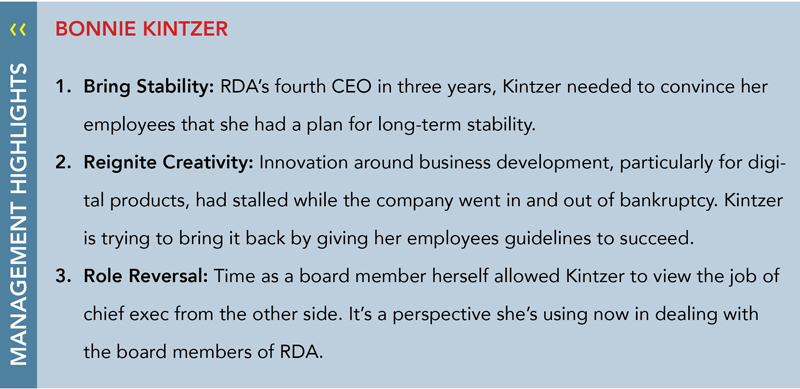
Reader’s Digest Association hired its fourth chief executive in three years last April, naming Bonnie Kintzer to the post. After working at RDA from 1998 to 2007, she came into the role more knowledgeable about the company than most other new CEOs would be.
Seven years away meant there was catching up to do though. Experience as a board member of F+W Media and Women’s Marketing Inc., and subsequently as CEO of Women’s Marketing Inc., also allowed Kintzer to expand her skillset in a few key areas that would be critical to achieving success back at RDA.
“I was gone for seven years and I knew how much I had changed in those seven years,” she says. “It started in the interview process and in conversations with the board of directors, and in giving me full access to financial plans and strategic plans. It was clear from looking at those documents that the company had changed dramatically.”
Survival Mode, the New Normal
Not only was RDA much smaller—just a fraction of the multi-billion dollar enterprise it was when she left—but perhaps more critically, operating in “survival mode” had become the norm.
As the company shifted in and out of bankruptcy under several different regimes, business development, and consequently, revenue, had stalled, particularly as it related to digital products. The underlying assets were strong enough to justify her belief that the company could be turned around, but they just weren’t being monetized.
Kintzer encountered more evidence of the problem once she took the job. She held 30-minute, 1-on-1 meetings with more than 100 of her new employees, about 25 percent of the company’s total workforce. There, she learned about why they stayed throughout the leadership changes, what they liked about the company and that they still held a pervasive focus on the customer. She also learned that innovation simply hadn’t been a priority.
“When I asked people how we could grow and tried to coax out new ideas, there were many people who couldn’t even fathom responses because they hadn’t been asked that question in so long,” she says.
“That was a critical lesson for me—one of the things we’d lost was a sensibility around how to launch new products and services.”
Kintzer knew that RDA still had a massive audience, a history of success with brand extensions and more than 100 years of content to leverage. What was missing was a corporate structure that allowed them to monetize those assets digitally. She knew that by rekindling the fire that made RDA a dominant worldwide publisher just a few short years ago, she could start to develop products that could resurrect the company. That process would involve coaching and bringing in fresh, creative thinkers who understood the economics of digital publishing.
While survival was the norm for most of her employees, not all of them fell into that category. Kintzer identified the individuals—chiefly in the company’s marketing department—who still had an aptitude for business development and has relied on them for the ideas that are now fueling the company’s growth.
Meanwhile, she’s taking steps to reignite the entrepreneurial spirit that once was so central to RDA. That coaching has largely taken the form of town hall meetings where Kintzer discusses the criteria employees should consider when coming up with new ideas for business development. Specifically, there are four questions she needs them to answer:
- Do we have permission to sell it?
- Does it leverage our existing assets?
- Is there an existing business model for it?
- Is it scalable?
While Nos. 1, 3 and 4 are applicable to most businesses, No. 2 is of particular importance to RDA and its 100-plus years of content. Kintzer admits they’re not fully there yet, but getting the company to leverage its rich history through modern, digital means remains a priority.
“In 2014, I was very disappointed in our digital sales progress. One of the things I saw in my pre-work before I got here was an un-monetized asset in our digital properties. I felt that we should be able to do more and ultimately came to the conclusion that what I really needed was digital leadership, and that’s what I’ve brought in,” she says.
Board Experience a Plus
Refocusing the company culture on growth has been one of Kintzer’s challenges, but getting owners and a board of directors to buy in to her plans has been just as critical.
She credits her time away from RDA—as a board member of two companies, and as CEO of a marketing agency—with teaching her how to deal with bosses in private equity.
“By the time I came back, I had worked very closely with private equity so I understood what was on the mind of the board and on the mind of investors,” she says. “Boards want you to always be mindful of financial issues, whether that’s cash or profit or growth. I’ve always had a strong financial aptitude, but I met with these people regularly so I stayed on top of their concerns. A good investor is concerned with the business mechanics, so it was my responsibility to make sure they understood the business in the most concise way. When I was asking for investment, I needed to have a very cogent argument and milestones to deliver on. So that was great training for here, because when I took this job, I was very clear with the board that I needed money to turn this company around and they’ve been extremely supportive.”
Aside from her own experiences, Kintzer has also relied heavily on others throughout the on-going transformation of RDA. Internally, she’s brought on a series of new execs, including a new chief revenue officer, chief financial officer, chief technology officer and a head of business analytics to help guide the company.
She’s also turned to mentors like Eric Schrier, CEO of RDA during Kintzer’s first stint with the company and a current board member, and Greg Coleman, president of BuzzFeed and a board member of Kintzer’s former company, Women’s Marketing Inc.
Together, the tactics are paying off already. The company launched the Taste of Home Online Cooking School in October—one of RDA’s first major launches under Kintzer. The platform leverages the print, digital and experiential content of a core brand at RDA—a jumping-off point for hundreds of cookbooks and live events in the past—in a way that’s more reflective of the modern consumer experience. The initiative also required a substantial investment that Kintzer got the board to approve.
The company as a whole is following suit. Eighteen months removed from its latest bankruptcy, RDA is now a profitable enterprise, Kintzer says, with each brand profitable independently. U.S. profits are on track to be up 30 percent in 2015 over prior year. 