How Quartz’s Native Ad Products Work
A custom approach has pushed 250-percent ad growth for the site since last year.
BY BILL MICKEY
How Quartz’s Native Ad Products Work
A custom approach has pushed 250-percent ad growth for the site since last year.
BY BILL MICKEY
How Quartz’s Native Ad Products Work
A custom approach has pushed 250-percent ad growth for the site since last year.
BY BILL MICKEY
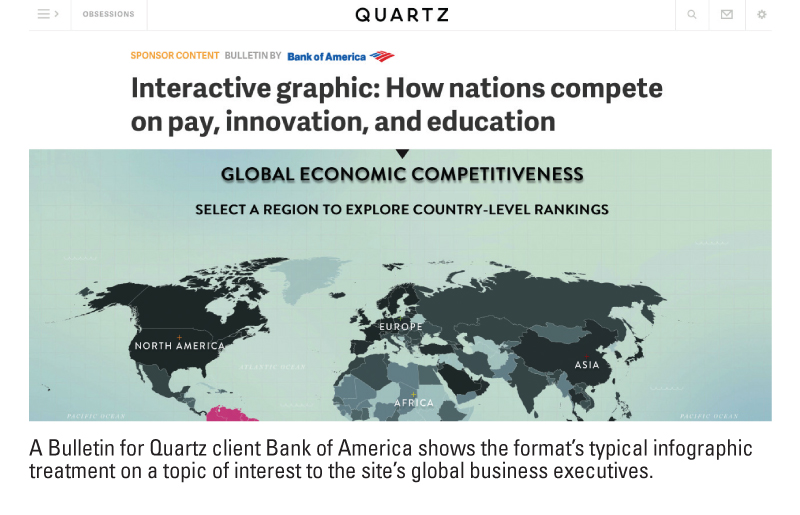
When Atlantic Media launched Quartz it designed the world and business news site to be mobile first. It was a platform choice that would have left it vulnerable to mobile’s less-than-attractive traditional advertising formats had it not developed a menu of native ad products. One of those is called Bulletin, an ad unit that allows the advertisers to use all of the same elements that the editorial staff has at their disposal to produce stories.
“We built [Quartz] with two things in mind,” says Marissa Hayes Aydlett, Quartz’s vice president of global marketing. “The first was building it to be mobile-first and second was to build an experience around the ads. We wanted to find a way to create an ad experience for users that fit in while also standing out. Our entire advertising strategy is to come up with really unique placements that work for the users.”
Ads Hiding in Plain Sight
Fitting in while standing out means designing ads that not only look like editorial content, but strive to have the same editorial value to the reader.
Bulletin ads are dropped right into the edit flow and appear after every two or three articles. Each ad is labeled as sponsored content. Advertisers have access to editorial tools to help shape their Bulletin to fit in—standard stories, data visualization tools, maps, chart builders, custom illustrations and so on. “Our partners have important things to say, too. It’s just as interesting for our readers,” says Aydlett.
Quartz offers another native format called Engage, which also appears between articles, but uses a more display-oriented strategy. The ads are full-bleed across the screen, responsive, and rely more on visuals like custom illustrations and video. Aydlett says advertisers use this format to emphasize their brand messaging.
Sales Strategy
A core characteristic of both the Bulletin and Engage products is the ability to take complex information and boil it down to easy-to-digest content packages. Again, the ads are modeled after what the Quartz editorial team has already been doing with its own storytelling, and Aydlett cites a piece the edit team wrote on U.S. immigration policy. “It’s an overwhelming story. A lot of places take the bill and just copy and paste it. So we did a piece that was very simple. We used visuals to describe the three paths to citizenship. We take that concept to the business side, what are the ways we can tell their story?”
Like publishers, brands are competing for the user’s time. And Quartz’s users are busy global business executives. “It’s about telling the story in the most efficient way you can—taking a complex story and simplifying it with a data visualization,” Aydlett says.
Production and creation of the ads fall on the marketing team, which typically works with client PR or ad agencies. Project managers handle a team of marketing designers, developers and engineers dedicated to each client. Content options “run the gamut,” she says. “We can reshape the client’s existing content or we can take publicly available data and stories and build them from the ground up with the client in mind.”
The native units are Quartz’s bread and butter—“We don’t run any standard IAB formats on our site,” says Aydlett. Advertising is projected to be up 250 percent in the first quarter of 2015 compared to the same period last year, with 90 advertisers working with the site. 