Print or Digital Determining Huge Differences in Pay
In marketing, female compensation equals men’s.
by Michael Rondon
Print or Digital Determining Huge Differences in Pay
In marketing, female compensation equals men’s.
by Michael Rondon
 rom database management to social media strategy, marketing and audience development departments often have commonalities. Certain tasks can rightly be assigned to either group, and responsibilities are frequently shared.
When it comes to compensation, there are significant distinctions between audience development and other forms of marketing, with a direct link to the platform—print or digital.
Marketers whose jobs are most closely tied to print, according to the 2015 Marketing and Audience Development Salary Survey, make up to 50 percent more than those working primarily with digital products.
Meanwhile, the opposite is true for audience developers—those working on digital platforms make an average of 34 percent more than colleagues on the print side.
It’s an interesting dichotomy that speaks to how publishers view those roles today. The relevance of audience development—formerly, circulation management—departments has been questioned as traditional notions of readership have eroded. But the higher salaries for Web-focused audience developers suggest that publishers are recognizing the value of digital readers and are willing to pay for them.
The correlation between experience and pay further backs up the idea that audience development departments are changing with the times. Experience matters less than skillsets in an evolving field, and whether it’s years in the industry, at a company or in a specific role, less means more in audience development—those with the least experience tend to out-earn veteran colleagues.
It’s less clear why a print-first mentality still rules in marketing compensation though.
Perhaps it’s their raw size? Smaller, nimbler departments like audience development can adjust priorities quickly, while larger units like marketing can take longer to pivot. The former hasn’t been a stranger to turnover in recent years either.
Maybe it’s their relationship to revenue? Despite its declines, print advertising still generates a majority of the dollars for consumer publishers, and a sizeable chunk for B2B media. In that light, rewarding print sales support personnel makes sense.
Or could it just be the way respondents self-identify? The verbatim answers are filled with marketers and audience developers noting additional tasks they’ve taken on in both print and digital forms, and across today’s multiplatform publishing world, specialization is increasingly rare. Everyone tends to do everything.
Whatever the rationale, the message is clear: platform expertise is impacting pay.
Methodology: Data was collected via online survey from April 22, to May 22, 2015. The survey was closed for tabulation with 1,254 total responses—a 2 percent response rate. The margin of error for percentages based on 1,195 tabulated responses is ±2.8 percentage points at the 95 percent confidence level. The margin of error for percentages based on smaller sample sizes will be larger.
Marketing Director
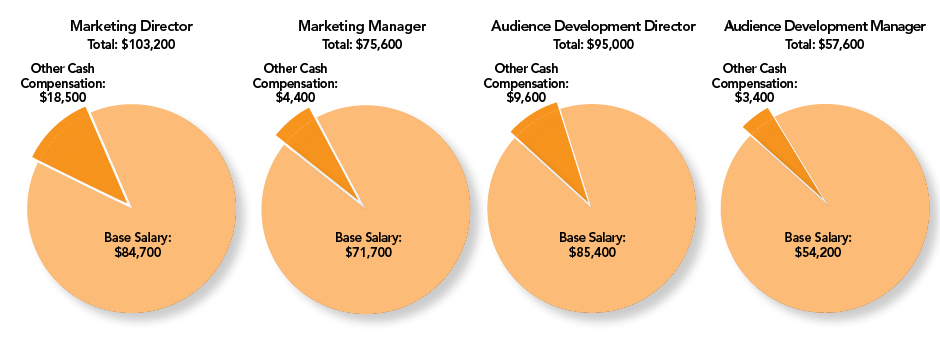
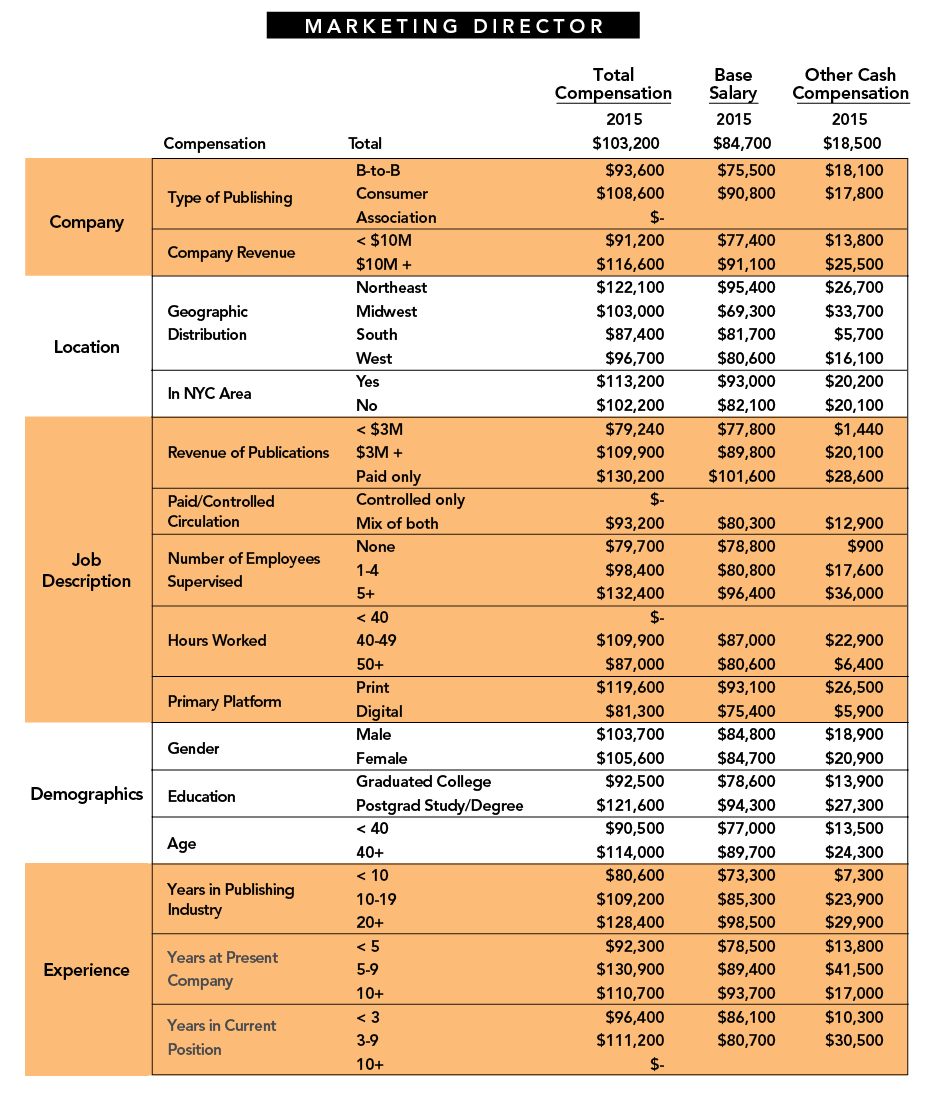
Marketing directors make an average of $103,200, but they’re not that happy about it. As a group, they reported the lowest satisfaction with pay in the survey.
That could have something to do with the size of the wage gap between the top of the field and the bottom. Posting the widest variance of any job title measured here, those in the 25th percentile make $68,300 in salary with no bonuses, while the 75th percentile takes home about $100,000 in regular pay and another $18,500 in additional cash compensation.
Looking the sources of that divide, platform expertise emerges as one of the biggest factors. Marketing directors who deal mainly with print make nearly $40,000 more than colleagues working primarily on digital, with about half of that difference attributable to salary and the other half to bonuses.
Staff size is also a major reason, respondents say. Those without any direct reports make about $19,000 less than marketers with up to four employees reporting to them, and a whopping $52,700 less than those overseeing departments of five or more.
Age plays a critical role as well—marketing directors 40-years-old and up make about $23,000 more than younger counterparts—though the impact of tangible experience is harder to quantify. Those failing to meet minimum thresholds for experience make less than marketing directors who surpass those marks, but the correlation ends there. More service time doesn’t necessarily equate to more money after a certain point.
Notably, there’s almost no difference in pay between men and women. In fact, female marketing directors tend to make slightly more than male colleagues—a trend that isn’t repeated anywhere else in the survey.
Marketing Manager
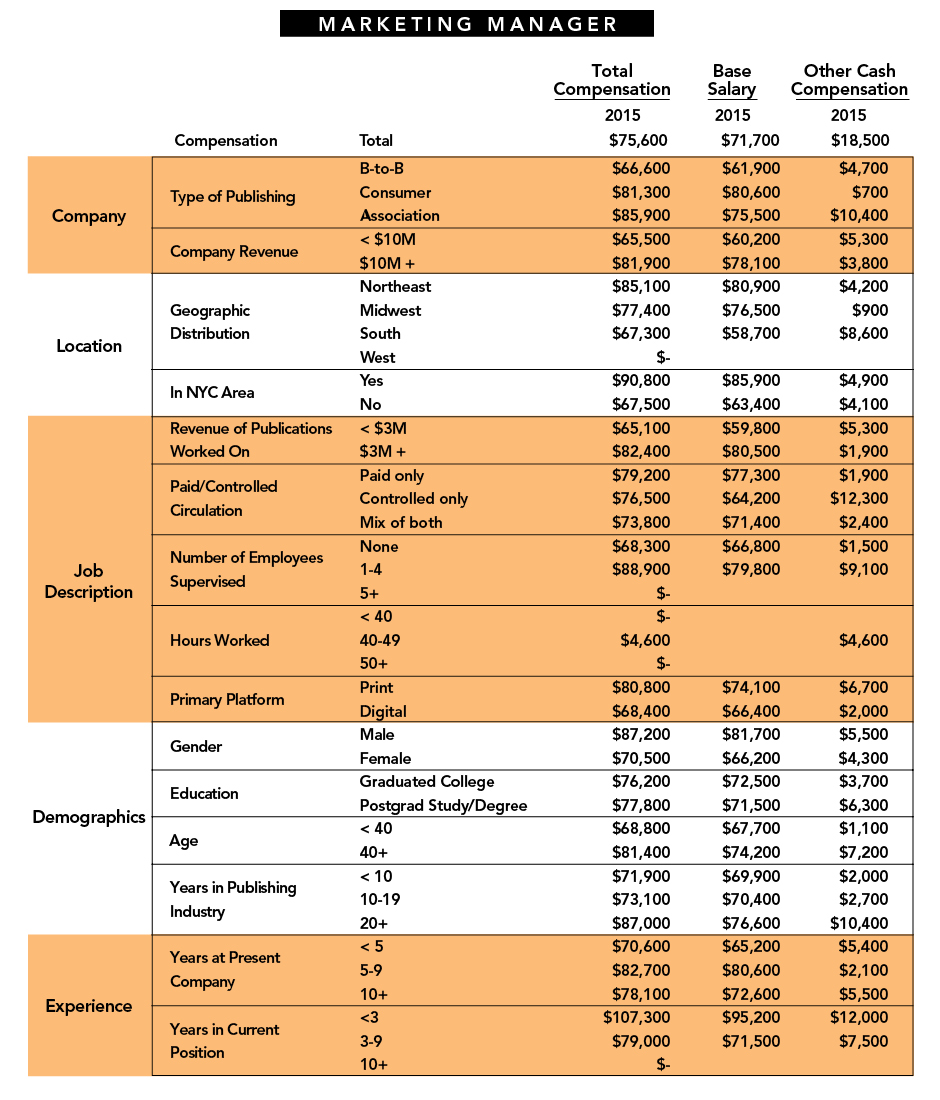
Making an average of $75,600, marketing managers report the highest level of satisfaction with pay in the survey.
In contrast to their director-level bosses, salaries at the manager level tend to be more egalitarian. Gaps between the high- and low-end of the spectrum are still significant—the difference between the 75th- and 25th-percentile earners is more than $36,000—but they’re much smaller on a categorical level.
The print-digital divide still exists, for instance, but it only accounts for a disparity of $12,400, respondents say, compared to almost three-times that for those at the director level. Similarly, education has almost no impact on pay for marketing managers, while a postgraduate degree can mean an additional $29,100 to marketing directors.
That means factors largely outside an employee’s control—things like company size (a $16,400 gap between the largest and smallest publishers), geography (living in the New York City area is good for an extra $23,300) and gender (men make about $16,700 more than women)—take on greater importance.
The role of experience is hard to quantify at the managerial level, as well. Differences in pay between the most- and least-practiced employees is usually less than $8,000.
Audience Development Director
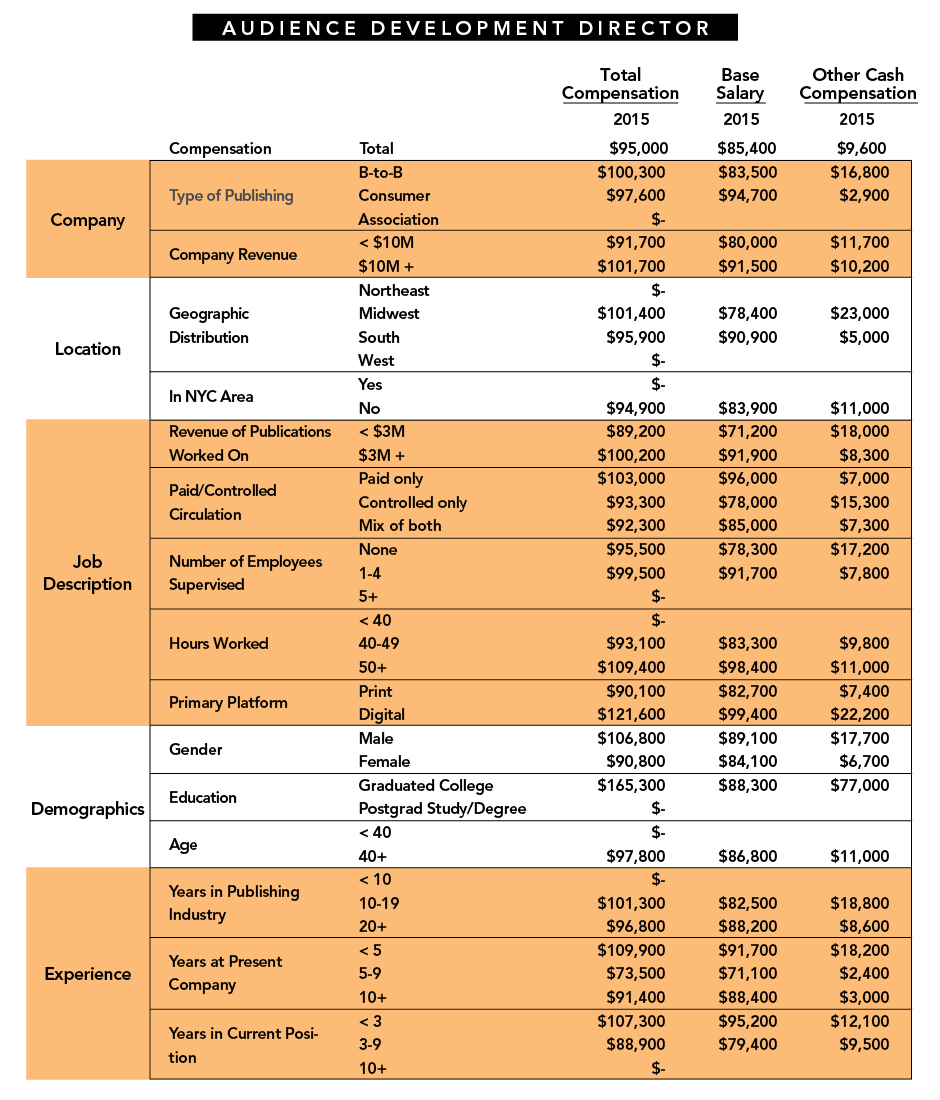
Audience development director compensation averages $95,000, and with a gap of just $27,000 between the highest- and lowest- earners at this level, it’s the most uniform pay structure in the survey.
Of the 15 categories published in the report, eight exhibit differences of $10,000 or less. Major traditional factors like the type of publisher, overall company revenue, location and the size of staff supervised hardly make an impact on compensation.
The first class on that list, the type of publisher, is especially noteworthy. While consumer publishers typically pay their marketers about $15,000 better than B2B companies do, that dynamic is flipped for audience development. The gap is only $2,700, but it’s surprising that audience developers in B2B actually made more.
The role of experience is turned upside down, as well, and much more noticeably. Any way you slice it (years in publishing, years at a company or years in a specific position) more time means less money—in some cases, more than $18,000 less.
Pay related to platform expertise also switches dramatically from the way marketers are paid. In fact, it’s by far the largest differentiator for audience development directors. Those who specialize in digital make an average of $31,500 more than their print-focused colleagues, split evenly between salary and additional cash compensation.
It’s impossible to know why experience and platform expertise in audience development are being valued the way they are, but as the industry shifts from print to digital, those skilled at the latter tend to become more valuable, regardless of how long they’ve been around.
Audience Development Manager
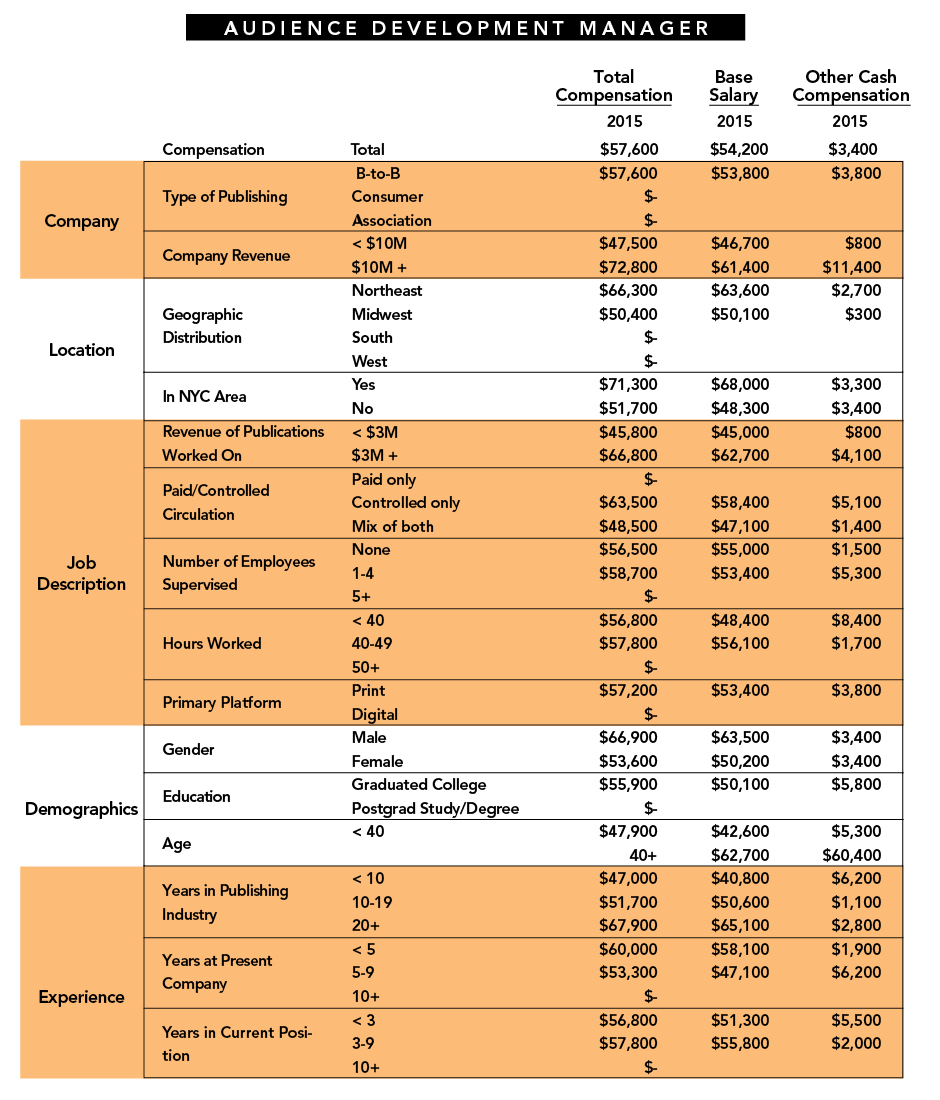
A lot like their director-level superiors, audience development managers are fairly satisfied with their pay, making an average of $57,600—$54,200 in salary and $3,400 in bonuses.
Data was a little more scarce for this job title, but a few points of differentiation do stand out.
First, there’s a very high variance from the top of the pay scale to the bottom. Those in the 75th percentile make more than $30,000 more than audience development mangers in the 25th percentile. While that’s on not far off the real-dollar gaps seen for marketing directors and managers, it’s much bigger as a percentage difference—top earners make almost 80 percent more than low-earning colleagues.
Revenue, usually a big factor in pay, also remains a major determinant in how audience development managers are compensated. Those working for companies with more than $10 million in revenue make about $25,300 more than those at smaller outfits, while managers of publications with at least $3 million in revenue earn $21,000 more than colleagues at titles below that threshold.
Job satisfaction isn’t the only area where audience development managers mirror their bosses either. It’s not as pronounced as it is at the director level, but a similar pattern around experience emerges—more time in the industry, at a company or in a specific role doesn’t necessarily equate to higher pay. 