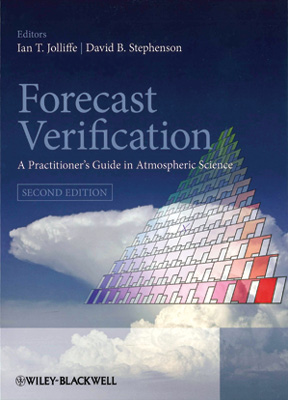
Forecast Verification: A Practitioner’s Guide in Atmospheric Science (Second Edition)
Ian T. Jolliffe and David B. Stephenson, Eds., 2012, 292 pp., $99.95, hardbound, Wiley-Blackwell, ISBN 978-0-470-66071-3
new publications
Writing Science in Plain English
A. Greene, 2013, 124 pp., $13.00, paperbound,
The University of Chicago Press, ISBN 978-0-226-02637-4
The author of this guide shows how writers from all scientific disciplines can learn to produce clear, concise prose by mastering a few simple principles. The book presents 12 such principles based on what readers need in order to understand complex information. The author illustrates each principle with real-life examples of both good and bad writing and shows how to revise bad writing to make it better. She ends each chapter with practice exercises so that readers come away with new writing skills after just one sitting. This book can be used by writers at all levels of their academic and professional careers.
Nonlinear Climate Dynamics
H. Dijkstra, 2013, 357 pp., $75.00, hardbound,
Cambridge University Press, ISBN 978-0-521-87917-0
This book introduces stochastic dynamical systems theory to synthesize the current knowledge of climate variability. Nonlinear processes play a central role in climate variability, and can give rise to transition phenomena, associated with tipping or bifurcation points, once external conditions are changed. Early chapters of the book present the stochastic dynamical systems framework and a hierarchy of climate models to study climate variability. Later chapters analyze phenomena such as the North Atlantic Oscillation ENSO, Atlantic multidecadal variability, Dansgaard-Oeschger events, Pleistocene Ice Ages, and climate predictability.
When the Sirens Were Silent: How the Warning System Failed a Community
M. Smith, 2012, 58 pp., $12.95, paperbound,
Mike Smith Enterprises, ISBN 978-0-692-01743-2
This book is a follow-up to Smith’s 2010 book, Warnings: The True Story of How Science Tamed the Weather. On May 22, 2011, 161 lives were lost when a tornado caught many residents of Joplin, Missouri, by surprise. This monograph addresses what went wrong with the warning system and looks at what can be done to build a more robust system in the future. The author provides material from survivors, scientific explanations, and photos of what happened that day. The book also contains removable pages with the latest safety rules for homes, school, and businesses.
REANALYSIS
Looking back at “News and Notes” in the Bulletin of February 1983:
EPA to Study Effects of Pollutants on the Heart
The U.S. Environmental Protection Agency (EPA) will soon be able to monitor changes in heart functions caused by exposure to toxic pollutants. . . . The EPA will validate a device, which will have a 10 h data sampling memory, through its Clinical Studies Facility in Chapel Hill, N.C. Three human volunteers, wearing the small, lightweight, battery-operated monitors during periods of rest and exercise, will be exposed to low levels of a variety of pollutants, such as ozone or carbon monoxide. . . . The data gathered in the studies will help provide a scientific foundation for future air quality standards based on the need to protect public health:
—Bull. Amer. Meteor. Soc., 64, 169
This book contains a series of chapters, written by disciplinary experts, on a range of topics relevant to forecast verification. These include deterministic forecasts of binary events, deterministic forecasts of multicategory events, deterministic forecasts of continuous variables, forecasts of spatial fields, probability forecasts, ensemble forecasts, economic value and skill, deterministic forecasts of extreme events and warnings, seasonal and longer-range forecasts, new directions in forecast verification, and verification software. There are many books on forecasting, but there is not, to my knowledge, any other book dedicated exclusively to forecast verification in the atmospheric sciences (and only one or two from other fields). There is, of course, the admirable chapter 8 in D.S. Wilks’s Statistical Methods in the Atmospheric Sciences, and as might be expected, there is a degree of overlap between the two sources. There are unique aspects to each, however, which might make one, or both, suitable choices, depending on the interests and needs of the reader.
This is the second edition of this title. Updates and additions include a revised chapter on spatial forecast verification, taking into account new research; separate chapters on probability forecasts and ensemble forecasts; a new chapter on forecasts of extreme events and warnings; a new chapter on seasonal and climate forecasts; and an appendix discussing the principles behind and some implementations of verification software.
Audience. While it is possible to obtain basic information on forecast verification through a variety of websites, owing to the breadth and complexity of this topic, this book is a useful additional resource. The text is advanced, but would be of use to graduate students, postdoctoral researchers, faculty, and practitioners interested in learning more about and applying these important—and in some cases, rapidly evolving—techniques.
This book would be a suitable for a graduate-level course or seminar on forecast verification and/or statistics (in the latter case, perhaps to augment treatments from Wilks). The layout is such that one could use the text to selectively design such a course, likely along with relevant publications, depending on the composition and goals of the class. Unlike Wilks, there are no exercises at the end of each chapter, but I do not view such problems as necessary for use in teaching, particularly at the graduate level.
Strengths. The breadth of topical coverage across 12 chapters is a significant strength. Further, with an average chapter length of 20 pages, the coverage is equivalent to a paper-length contribution on each subject, sufficient to get into the weeds but not be lost among them. The chapters on extreme-events forecasting, seasonal forecasting, new directions, and software are all unique contributions not covered in Wilks’s book. Furthermore, chapter 6 addresses the still-developing area of spatial forecast verification in much greater detail than was possible in Wilks.
Weaknesses. This book attempts to focus on the specific area of forecast verification, and in so doing, to provide more comprehensive coverage on that topic. It largely succeeds, but even with this reduced scope, one is left wanting more details. In that regard, the text at least provides enough background and references to point such a reader in the right direction (see, for example, the chapter on economic value and skill).
Illustrations. The figures adequately illustrate the points raised in the text. A “wish list” item would be more extensive use of color figures, with those figures embedded in the chapters rather than as an insert in the middle of the volume. Clearly, the more limited use of color was chosen to keep the price lower, since as students are all too aware, disciplinary texts are quite expensive.
Bottom Line. As noted previously, Wilks is the only other book of which I am aware that has any extensive treatment of forecast verification in the atmospheric sciences. I would use the two books together, since they are complementary treatments of this broad topic.
I am pleased to have a copy of this book, and I would recommend it to others interested in this subject.
—Paul J. Roebber
Paul Roebber is a distinguished professor and associate dean for academic affairs at the University of Wisconsin, Milwaukee. He is also the director of Innovative Weather.
FOR FURTHER READING
Wilks, D. S., 2011: Statistical Methods in the Atmospheric Sciences. 3d ed. Academic Press, 676 pp.