Study Forecasts Greater Hurricane Frequency, Intensity
Sumatra Fires Cover Singapore with Smoke
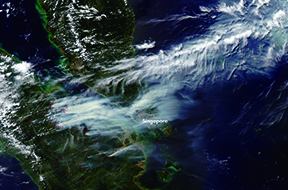
Illegal fires burning on the Indonesian island of Sumatra in June sent massive amounts of smoke eastward, leading to record-setting pollution levels in Singapore. The nation’s Pollutant Standards Index—an air-quality indicator that ranges from 0 to 500—reached 401 on June 21. This was the highest rating in Singapore’s history and the first time the index had ever reached the “hazardous” level of at least 300.
This image, taken by the Moderate Resolution Imaging Spectroradiometer (MODIS) on board NASA’s Aqua satellite, shows the smoke originating at the left from forest fires started by farmers in Sumatra who use the slash-and-burn method of clearing their land for new crops. Singapore is in the center of the photo at the southern tip of Malaysia (parts of which were also smothered by smog from the fires). Singapore’s Prime Minister, Lee Hsien Loong, sent a letter to Indonesian President Susilo Bambang Yudhoyono expressing “serious concern” about the smoke; Agung Laksono, the minister coordinating Indonesia’s response to the haze, reacted by stating that “Singapore should not be behaving like a child and making all this noise,” but Yudhoyono issued a public apology for the pollution a few days later. According to Greenpeace, half of the fires detected in the days before the record-setting smoke originated from locations where clearing forests is prohibited by an Indonesian moratorium. (SOURCE: Bloomberg News)
A new study published in the Proceedings of the National Academy of Sciences is predicting an increase in both the number and strength of tropical cyclones in the future, countering the findings of studies in the last decade that indicated hurricanes would occur less frequently as global temperatures increase.
The research utilized a downscaling approach in which high-resolution regional and storm-scale models are run within the framework of global climate models. The technique was explained in the March 2008 issue of BAMS; the new research improved upon that technique by utilizing the latest global climate models (CMIP5—Coupled Model Intercomparison Project Phase 5—vs. CMIP3 in the earlier study). It compared the frequency and intensity of tropical cyclones from the period 1950–2005 with that of simulations for 2006–2100 in which global greenhouse gases increase quickly amid limited efforts to reduce them. For the twenty-first-century projections, the models showed a 45% increase in the “Power Dissipation Index”—an indicator of both a hurricane’s wind speed and life span—and a 40% increase in the number of hurricanes with an intensity of Category 3 or higher.
“We see an increase, in particular, toward the middle of the [twenty-first] century,” says the study’s author, Kerry Emanuel of the Massachusetts Institute of Technology. “The results surprised us, but we haven’t gotten so far as to understand why this is happening.”
The models showed the greatest escalation of tropical cyclone activity occurring in the western North Pacific, but they also indicated more frequent storms in other regions, except for the southwestern Pacific.
Emanuel told the website ClimateCentral.org that he suspects the projected uptick in hurricane activity and intensity “has more to do with projected decreases in manmade aerosols than with increasing carbon dioxide [emissions].” This idea is supported by another recent study that identified a direct connection between cleaner air over the Atlantic Ocean and increasing numbers of hurricanes in the region. That research, published in Nature Geoscience, used simulations from a collection of climate models covering the period 1860–2050 to determine that anthropogenic aerosols, with their ability to brighten clouds and thus reflect more solar energy back into space, stifled hurricane activity during the middle and latter part of the twentieth century.
“Industrial emissions from America and Europe over the twentieth century have cooled the North Atlantic relative to other regions of the ocean,” explains study lead author Nick Dunstone of the Met Office. “Our research suggests that this alters tropical atmosphere circulation,” which the study determined was limiting hurricane formation. But now that aerosol levels have dropped, the hurricanes have returned. (Sources: LiveScience.com; RedOrbit.com; ClimateCentral.org)