Avoidance of spectral overlaps on reaction product ions with O2 cell gas: Comparison of quadrupole ICP-MS and ICP-QQQ
Ed McCurdy
Agilent Technologies (UK) Ltd.
Keywords
titanium, reaction chemistry,
oxygen mass-shift
Introduction
The 8800 ICP-QQQ opens up many new analytical possibilities and novel methodologies for interference removal based on reaction chemistry. The major benefit provided by the 8800 ICP-QQQ is its unique tandem mass spectrometer configuration, which permits operation in MS/MS mode. In MS/MS, the first quadrupole (Q1) operates as a 1 amu mass filter, providing precise selection of the ions that can enter the reaction cell, and therefore control of the reaction processes that occur. This level of reaction process control is fundamentally different to the operation of conventional quadrupole ICP-MS (ICP-QMS) when using these same reaction chemistries, as ICP-QMS has no way to reject ions before they enter the cell, and so cannot select which ions are involved in the reactions.
This difference is apparent in many reaction chemistries, including both on-mass measurements (where the interfering ions are reactive and are moved away from the analyte ions, which are then measured at the natural mass), and mass-shift methods (where the analyte ions are reactive and are moved to a new product ion mass that is free from the original overlap). Overlaps on analyte product ions commonly occur in ICP-QMS and can give severe errors in results, especially in cases where the sample matrix or co-existing analyte levels vary from sample to sample.
In this note, we compare the performance of ICP-QMS (the 8800 ICP-QQQ operated in Single Quad mode with Q1 as a bandpass filter) and ICP-QQQ (the 8800 ICP-QQQ operated in MS/ MS mode) for the measurement of titanium (Ti) as TiO+ product ions, using oxygen reaction mode (O2 mode).
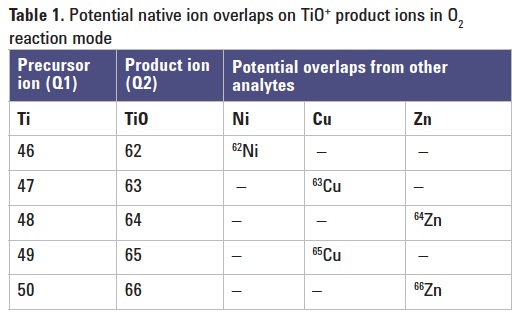
The native ion overlaps that could affect the measurement of TiO+ product ions with oxygen reaction gas are shown in Table 1. It should be noted that these native ion overlaps cannot be rejected by the cell bandpass settings of a conventional quadrupole ICP-MS, because they occur at the same mass as the analyte product ion being measured.
Experimental
For the spectral comparison, scan data were collected for the mass range from
m/z 60 to 69, covering the TiO+ product ions formed from Ti in O2 reaction mode.
Instrumentation: Agilent 8800 #100.
Plasma conditions and ion lens tune: Preset plasma/General purpose,
Soft extraction tune: Extract 1 = 0 V,
Extract 2 = -180 V.
CRC conditions:
Cell gas = O2 gas at 0.3 mL/min,
Octopole bias = -5 V, KED = -7 V.
Acquisition parameters:
Scan range = m/z 60 to 69;
points per peak = 20;
integration time per mass = 1 sec.
Results and discussion
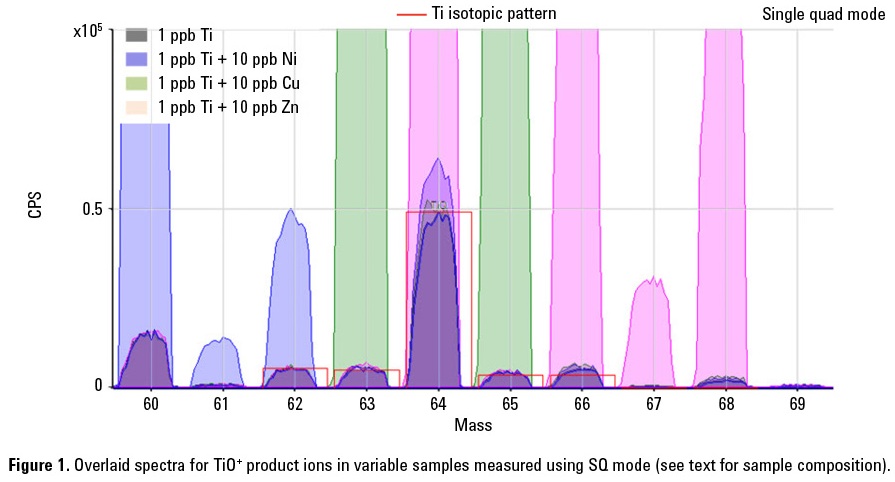
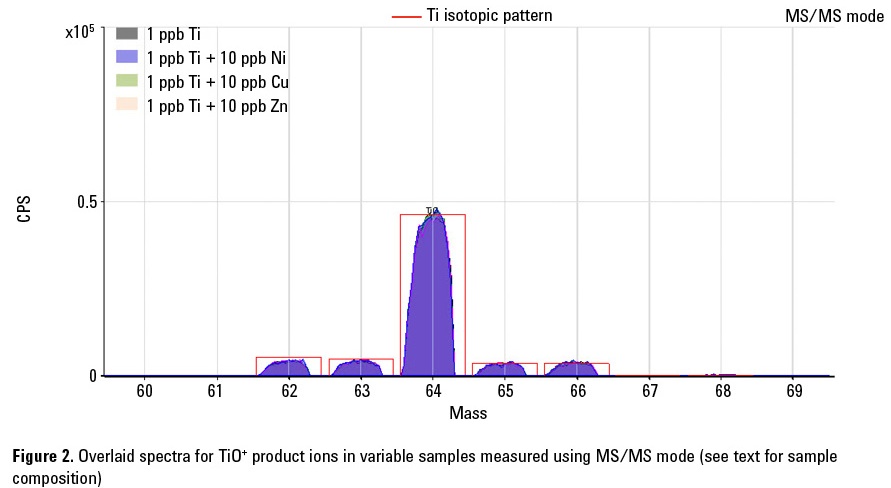
The comparative results for TiO+ measured in Single Quad (SQ) mode and MS/MS mode are shown in the overlaid spectra in Figures 1 and 2. In both cases, the TiO+ ions at mass 62, 63, 64, 65 and 66 (from the 5 isotopes of Ti at 46, 47, 48, 49 and 50, respectively) are shown, measured using the same O2 reaction mode conditions for both modes. The four solutions measured for the overlaid spectra are:
- 1 ppb Ti in 1% HNO3
- 1 ppb Ti + 10 ppb Ni in 1% HNO3
- 1 ppb Ti + 10 ppb Cu in 1% HNO3
- 1 ppb Ti + 10 ppb Zn in 1% HNO3
The overlaid spectra in Single Quad mode, shown in Figure 1, show that the peaks for the five TiO+ isotopes match the theoretical isotopic template in the 1 ppb Ti sample. However, in the other samples containing the elements Ni, Cu and Zn, all of the TiO+ product ions suffer significant overlap from the native Ni (m/z 62), Cu (m/z 63 and 65) and Zn (m/z 64 and 66) ions. Unexpected or variable levels of these common elements would lead to an error in the reported results for Ti measured as TiO+ using quadrupole ICP-MS in O2 reaction mode.
In contrast, the overlaid spectra for MS/MS mode, shown in Figure 2, demonstrate consistent measurement of all five TiO+ product ions in all four solutions. The presence of the other elements Ni, Cu and Zn has no impact on the TiO+ peaks and all five TiO+ product ion isotopes could be used to give reliable results for Ti in these variable samples. This illustrates how MS/ MS mode on the 8800 ICP-QQQ can simplify method development, because consistent cell conditions, acquisition parameters and isotope selection can be used for a range of variable sample types. A further benefit is that interferences are removed from all isotopes under the same cell conditions, so secondary (or qualifier) isotopes become available for data confirmation or isotope analysis.
Conclusions
The comparative spectra presented in this note illustrate the improved accuracy and consistency delivered by ICP-QQQ operating in MS/MS mode, compared to a conventional quadrupole ICP-MS using a reaction cell with bandpass filter. By rejecting non-target native ions that would occur at the same mass as analyte product ions, potential interferences can be eliminated by MS/MS. This allows simpler, more consistent method development, as well as improving accuracy for interfered elements in complex and variable samples.