The accurate measurement of selenium in reference materials using online isotope dilution

Naoki Sugiyama
Agilent Technologies, Japan
Keywords
selenium, environmental, agricultural, human health, online isotope dilution analysis, OIDA, oxygen mass-shift
Introduction
Selenium (Se) is an important element in environmental and agricultural studies and in human health, as it is an essential trace nutrient but is toxic in excess. The role of certain chemical forms of Se is the subject of significant research into cancer prevention. ICP-MS is the analytical method of choice for both total and speciated Se measurements, but Se is a difficult element to quantify accurately at trace levels by ICP-MS for several reasons:
- The signal for Se is low, since it is poorly ionized in the plasma due to its high Ionization Potential (IP) of 9.75 eV.
- Because Se is poorly ionized, it suffers signal suppression in high matrix samples — an issue that is further compounded by the lack of a suitable internal standard element with a similar mass and IP.
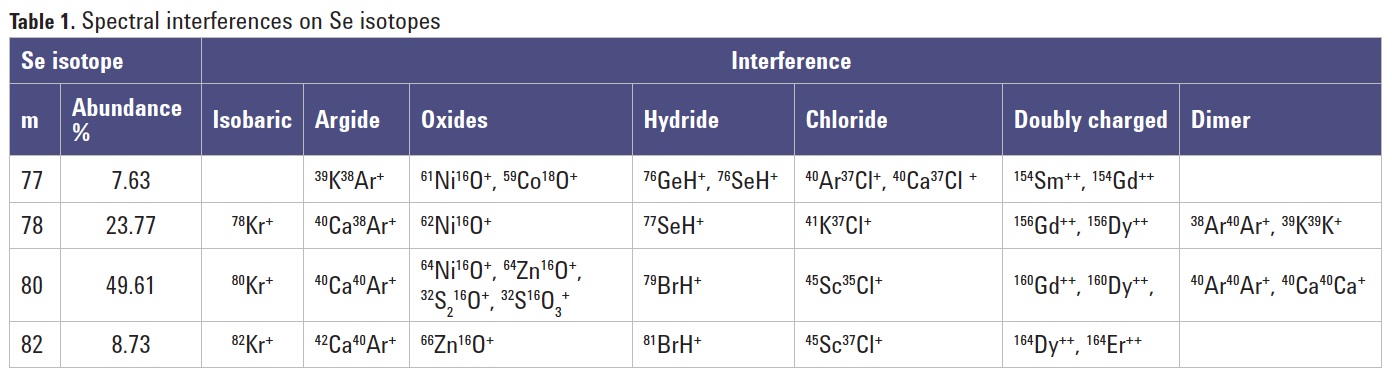
- All the analytically useful Se isotopes suffer from multiple spectral interferences, as summarized in Table 1.
- The resolution required to separate all of the spectral interferences is beyond the capabilities of sector-type high resolution (HR-)ICP-MS.
The Agilent 8800 ICP-QQQ in MS/MS mode has a unique ability to remove the complex spectral interferences from all the Se isotopes shown in Table 1, allowing the use of Isotope Dilution (ID) analysis, which requires at least two interference-free isotopes. ID is the most accurate quantification technique as it is based on direct measurement of isotopic abundances in each sample, rather than a relative measurement of analyte response compared to a standard. As a result, it offers better traceability and improved correction of non-spectroscopic interferences encountered in high matrix sample analysis. This note describes the application of the Agilent 8800 ICP-QQQ using ID for the accurate quantification of Se in a range of certified reference materials (CRMs).
Experimental
Instrumentation: Agilent 8800 #100.
Plasma conditions: Preset plasma/General purpose.
Ion lens tune: Soft extraction tune:
Extract 1 = 0 V, Extract 2 = -180 V.
CRC conditions: O2 gas at 0.4 mL/min plus H2 gas at 2.0 mL/min, Octopole bias = -18 V and KED = -6 V.
Acquisition parameters: MS/MS O2 mass-shift method. The reaction of Se+ with O2 to form SeO+ is endothermic (∆Hr = 0.71 eV) , but the reaction is efficiently promoted using high collision energy using a low octopole bias voltage setting [1]. Preliminary studies have shown that low BEC for Se isotopes can be achieved via the addition of a small amount of H2 in MS/MS O2 mass-shift method.
Method: Online isotope dilution analysis (OIDA) [2] was used. OIDA is a useful development of traditional isotope dilution, as it removes the time consuming step of spiking enriched-isotope standards into each individual sample. A 82Se enriched standard purchased from Oak Ridge National Laboratory (USA) was prepared at the appropriate concentration and added via the standard online ISTD mixing kit to the samples. Productions derived from the 16O-atom addition transition were measured for the three most analytically useful isotopes of Se. On the 8800 ICP-QQQ, this is simply achieved by defining the acquisition method with Q1/Q2 settings: Q1=78/Q2=94, Q1=80/Q2=96 and Q1=82/Q2=98 for the Se isotopes at m/z 78, 80 and 82 respectively.
It should be noted that the use of MS/MS (where Q1 acts as a 1 amu mass filter) is essential for this measurement, as it ensures that only one Se isotope enters the cell for any given mass pair measurement, and only the 16O atom addition is measured because the mass difference between Q1 and Q2 is 16 amu. This ensures that there is no overlap due to the precursor ions from different Se+ isotopes giving SeO+ product ions at the same mass, such as the 80Se18O+ product ion overlap on 82Se16O+, both of which appear at m/z ICP-QQQ in MS/MS mode thereby removes one of the critical limitations of reaction chemistry with ICP-QMS, where all the sample ions enter the cell together so no specific reaction transition can be defined. Each Se isotope mass pair was measured with an integration time of 1 s and three replicates.
Sample preparation: The CRMs were microwave digested using a Milestone ETHOS closed vessel microwave digestion system (Milestone, Sorisole, Italy) and following the manufacturer’s recommended procedures. The final dilution factor of the samples varied from 250 to 500x.
Results and discussion
Study of cell gases for spectroscopic interference removal
Figure 1 shows the result of a preliminary study of the effects of the choice of cell gas on interference removal. The findings of the study showed that O2/H2 mass-shift (Figure 1) enables the measurement of 78Se, 80Se and 82Se relatively free from interferences in the range of synthetic matrices tested.
Measurement of Se in CRMs
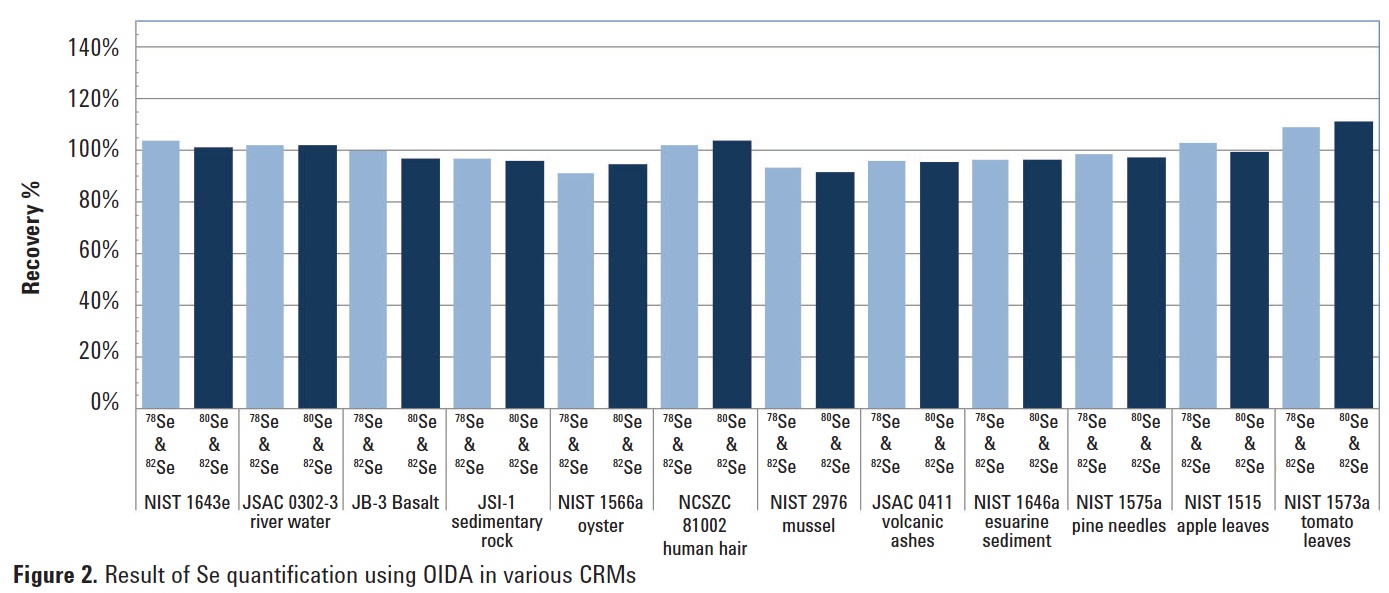
The concentration of Se was determined in 12 different CRMs using the OIDA method. The CRMs were obtained from NIST (Gaithersburg MD, USA), GSJ Geochemical Reference Samples (Tokyo, Japan), Japan Society for Analytical Chemistry (Tokyo, Japan), and National Institute of Metrology (Beijing, China). The matrices included environmental waters (NIST 1643e and JASC 0302-3 River Water), rock (JB-3 basalt), sedimentary rock (JSI-1 and NIST 1646a Estuarine Sediment), soil (JSAC0411 Volcanic Ash Soil), biological samples (NIST 1566a Oyster Tissue, NCSZC 81002 Human Hair, NIST 2976 Mussel Tissue), and plant materials (NIST 1575a Pine Needles, NIST 1515 Apple Leaves, NIST1573a Tomato Leaves).
Figure 2 shows the Se results for each CRM expressed as % recovery relative to the certified value. The measured results for Se were in good agreement with the CRM values (90%-112%), using two Se isotope pairs: 78/82 and 80/82. This demonstrates the effectiveness of the Agilent 8800 ICP-QQQ in MS/MS mode for the removal of multiple interferences on 78Se, 80Se and 82Se.
References
- Agilent 8800 Triple Quadrupole ICP-MS: Understanding oxygen reaction mode in ICP-MS/MS, 2012, Agilent technical overview, 5991-1708EN
- On-line isotope dilution analysis with the 7700 Series ICP-MS: Analysis of trace elements in high matrix samples, Giuseppe Centineo, Jose Angel Rodriguez Castrillon and Esther Munoz Agudo, 2011, Agilent application note, 5990-9171EN
More information
The accurate measurement of selenium in twelve diverse reference materials using on-line isotope dilution with the 8800 Triple Quadrupole ICP-MS in MS/MS mode, Agilent application note, 5991-0259EN.