Direct measurement of trace rare earth elements in high purity REE oxides

Kazumi Nakano
Agilent Technologies, Japan
Keywords
Rare Earth Elements, REE, rare earth oxide, REO, samarium oxide, gadolinium oxide, oxygen mass-shift, ammonia on-mass
Introduction
The rare earth elements (REEs) are widely used in advanced technologies including high-power permanent magnets, lasers, phosphors used in fluorescent lamps, radar screens and plasma displays. REEs are also used in petroleum refining, automobile catalytic converters and batteries, and in high-technology glasses. It is clear from these examples that REEs play a key role in many types of materials used in high-technology industries. However, the presence of other REEs as contaminants in a purified single-element REE material often impacts the functionality of the final product, so impurities in the REE oxide raw material must be carefully controlled.
ICP-MS is the most commonly used atomic spectrometry technique for the measurement of trace REEs due to its simple REE spectra — particularly when compared to emission techniques. The measurement of mid- and high-mass REEs in a low-mass REE matrix is, however, very challenging for ICP-MS because REEs have among the highest metal-oxide (M-O) bond strengths of any element, and the oxide ions of the low mass REE overlap the preferred isotopes of the mid-mass and high-mass REEs. Table 1 shows the interferences observed in the analysis of trace REEs in high-purity samarium (Sm) oxide and gadolinium (Gd) oxide.
Separation of the trace REE analytes from the REE matrix can be performed utilizing a chelating resin, but this technique is time-consuming and customization is needed according to the analyte and matrix element. The direct analysis of trace REEs in a variety of high-purity REE matrices is therefore desired. In this work, an Agilent 8800 Triple Quadrupole ICP-MS was used for the direct analysis of trace REE in two high-purity REE materials: Sm2O3 and Gd2O3. Operating the ICP-QQQ in MS/MS mode effectively removes the challenging interferences, enabling the determination of REE impurities at trace levels in these two materials.
Experimental
Instrumentation: Agilent 8800 #100.
Plasma conditions: Preset plasma/General purpose.
Ion lens tune: Soft extraction tune:
Extract 1 = 0 V, Extract 2 = -180 V.
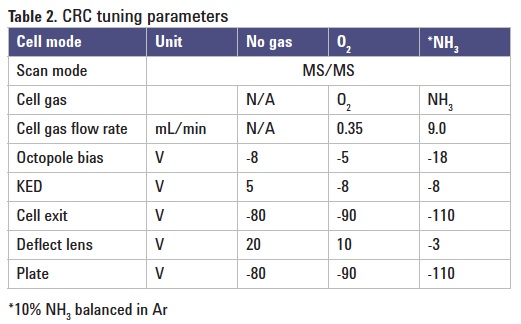
Acquisition parameters: Three cell modes were used with MS/MS acquisition: No gas, O2 mass-shift, and NH3 on-mass mode. In MS/MS O2 mass-shift mode, the REEs were determined as their oxide ions. REE ions react efficiently with the O2 cell gas and are converted to the oxide ion REE-O+. For example, in the measurement of 153Eu+, Q1 is set to m/z 153 (153Eu+) and Q2 is set to m/z 169 (153Eu16O+). Cell tuning parameters are summarized in Table 2.
Results and discussion
Two high purity REE oxide materials
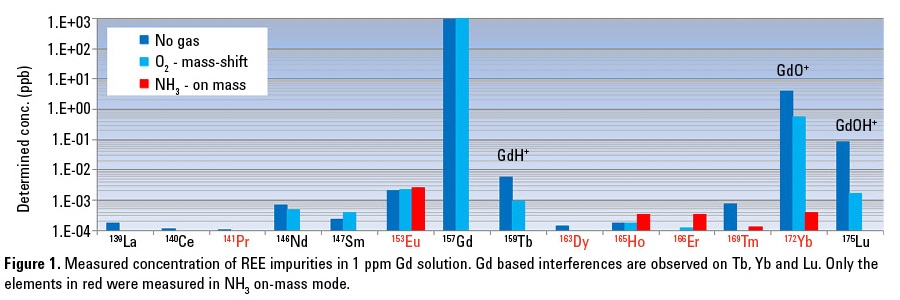
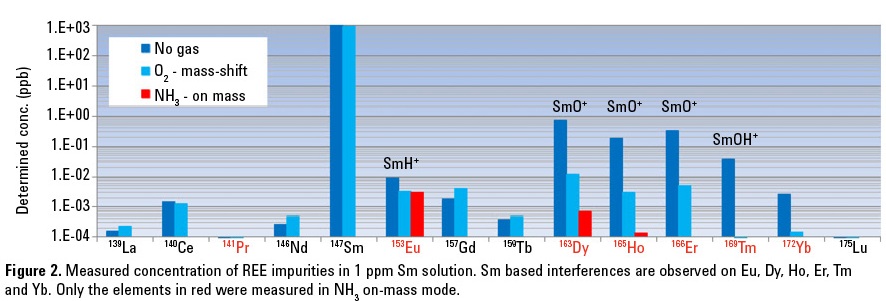
Gd2O3 (5N) and Sm2O3 (4N8) were gently dissolved in semiconductor grade HNO3 and diluted to a concentration of 1 ppm (as the REE). The other (trace) REEs were measured in each matrix solution using the three cell modes. The results are given in Figure 1 and Figure 2. As expected, analysis of the 1 ppm Gd solution in no gas mode gave positive errors on some elements due to interferences from Gd polyatomic ions: GdH+ interferes with 159Tb+, GdO+ interferes with 172Yb+ and GdOH+ interferes with 175Lu+.
Preliminary studies showed that NH3 cell gas reacts with many of the polyatomic ions that interfere with the REE. However, NH3 also reacts quickly with some of the REE ions, leading to reduced sensitivity of < 1 cps/ppt [1], so this mode is only suitable for the measurement of the less reactive analytes: Pr, Eu, Dy, Ho, Er, Tm and Yb. For these elements, NH3 on-mass mode gave excellent results, including for Yb in the Gd matrix, where the measured Yb background concentration was reduced by four orders of magnitude (Figure 1) indicating effective removal of the GdO+ overlap. Background signals for Dy, Ho, Er and Tm in the Sm matrix were also dramatically improved (Figure 2).
For the REEs that react with NH3
(La, Ce, Nd, Sm, Gd, Tb and Lu), O2 mass-shift mode and measurement of the target analyte as its REE-O+ ion is the preferred approach. Most REEs are effectively converted to the oxide ion via reaction with O2 cell gas [1], and this mode was applied to the measurement of Lu in the Gd matrix, avoiding the GdOH+ interference on the Lu+ isotope and giving a good improvement in the background signal. Compared to no gas mode, O2 mass-shift mode also gave a good improvement in the background signals for Dy, Ho, Er, Tm and Yb in the Sm matrix, but for all these analytes the backgrounds in NH3 mode were lower still.
Reference
- Direct measurement of trace rare earth elements (REEs) in high-purity REE oxide using the Agilent 8800 Triple Quadrupole ICP-MS with MS/MS mode, Agilent application note, 5991-0892EN.