Manganese analysis in whole blood: Expanding the analytical capabilities of ICP-MS
Amir Liba
Agilent Technologies, USA
Keywords
manganese, whole blood, iron, abundance sensitivity, helium MS/MS
Introduction
Analysis of clinical samples is challenging due to their complex matrices. While
ICP-MS is an immensely powerful
multi-element analytical technique, it does suffer from some well-documented spectral interferences. Achieving low detection limits is limited by background signal from low level impurities and the presence of polyatomic interferences, which require the use of CRC technology for their removal. Although the use of CRC-ICP-MS has alleviated many of these analytical challenges, some spectral interferences remain problematic for quadrupole ICP-MS (ICP-QMS). One such interference is the signal overlap on 55Mn due to peak tailing from both 54Fe and 56Fe. Whole blood contains an average of 500 ppm of Fe, and with the level of Mn in whole blood being roughly 10 ppb, analytical results for Mn tend to bias high due to the significant signal tailing and overlap from the adjacent Fe peaks. In this work, we use the superior abundance sensitivity of the 8800 ICP-QQQ to remove any signal overlap from Fe on Mn in whole blood.
Experimental
Instrumentation: Agilent 8800 #100.
Plasma conditions and ion lens tune: Preset plasma/General purpose with soft extraction tune: Extract 1 = 0 V.
Method: Samples were analyzed using the 8800 ICP‑QQQ in both Single Quad (SQ) mode and MS/MS mode. In this study, the mass range of interest (from m/z 50 to 60) was scanned at twenty points per peak in both no gas and helium (He) modes. For the analysis of Mn in blood, MS/MS mode with on-mass measurement (Q2 set to the same mass as Q1) was used, with helium cell gas (typical flow of 4.3 mL/min) to remove polyatomic ion interferences such as
FeH+ and ArOH+.
Sample preparation: A 5 ppb solution of Mn was prepared from a stock of
1000 ppm Mn and either analyzed separately or spiked into “base” whole blood (low level Mn). Whole blood was diluted using an alkali matrix containing ammonium hydroxide, EDTA, Triton X-100, and butanol.
Abundance sensitivity
The abundance sensitivity (AS) of a mass spectrometer is the contribution that the signal at mass M makes to the signals at the adjacent masses (M±1), expressed as a ratio (M-1/M on the low-mass side and M+1/M on the high-mass side). Simply put, AS is the measure of the “peak tailing” to adjacent masses, which will contribute to a false positive signal, such as that seen on 55Mn (present at trace levels) from the large contribution from 54Fe and 56Fe (which exists at very high concentration) in whole blood. The abundance sensitivity of the best quadrupole ICP-MS systems is of the order of 10-7.
Results and discussion
Abundance sensitivity study in SQ and MS/MS mode
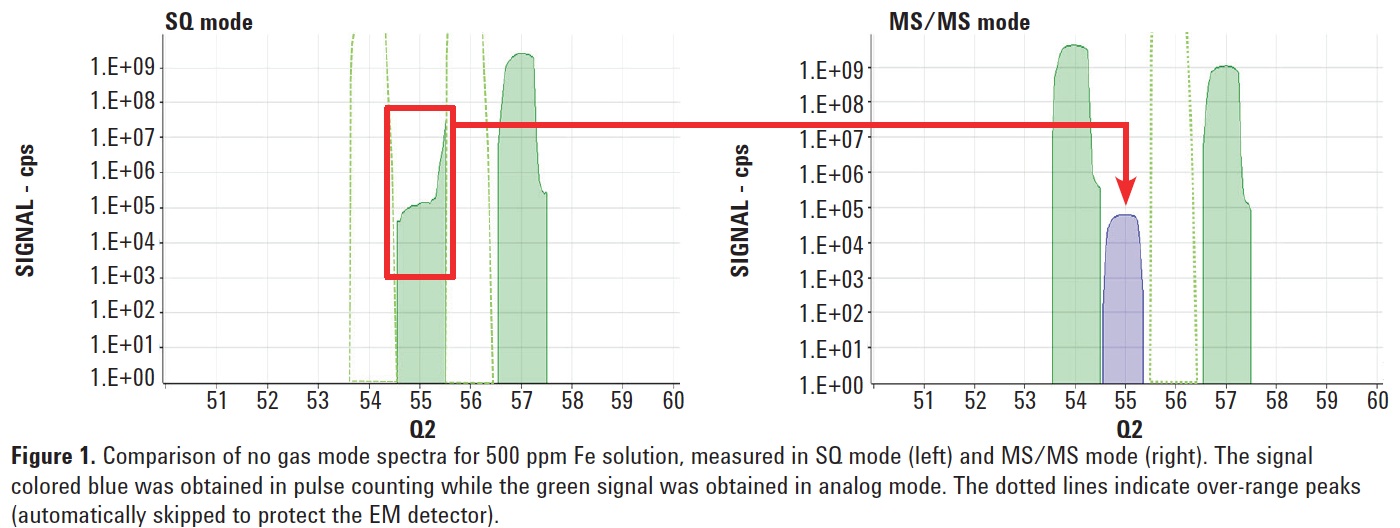
SQ and MS/MS spectra for a 500 ppm Fe solution acquired in no gas mode are shown in Figure 1. The spectrum on the right illustrates the superior peak-to-peak resolution of the 8800 ICP-QQQ operated in MS/MS mode. Although no interference removal for polyatomic ions was employed, the elimination of the contribution to mass 55 from adjacent peaks is clearly evident in MS/ MS mode. The “flat-top” peak shapes are the result of the logarithmic scale.
Abundance sensitivity plays an important role when samples contain a large concentration of Fe. Figure 1 looks at the contribution of “peak tailing” on 55Mn due to high levels of Fe. The high concentration of Fe together with the ArN+ and ArO+ contribution in no gas mode resulted in the signals at 54 and 56 being over the range of the detector, and so they were automatically skipped. However, the signal contribution from 56Fe on mass 55 is clearly visible in the SQ mode (indicated by the red box) while it is absent in the MS/MS mode.
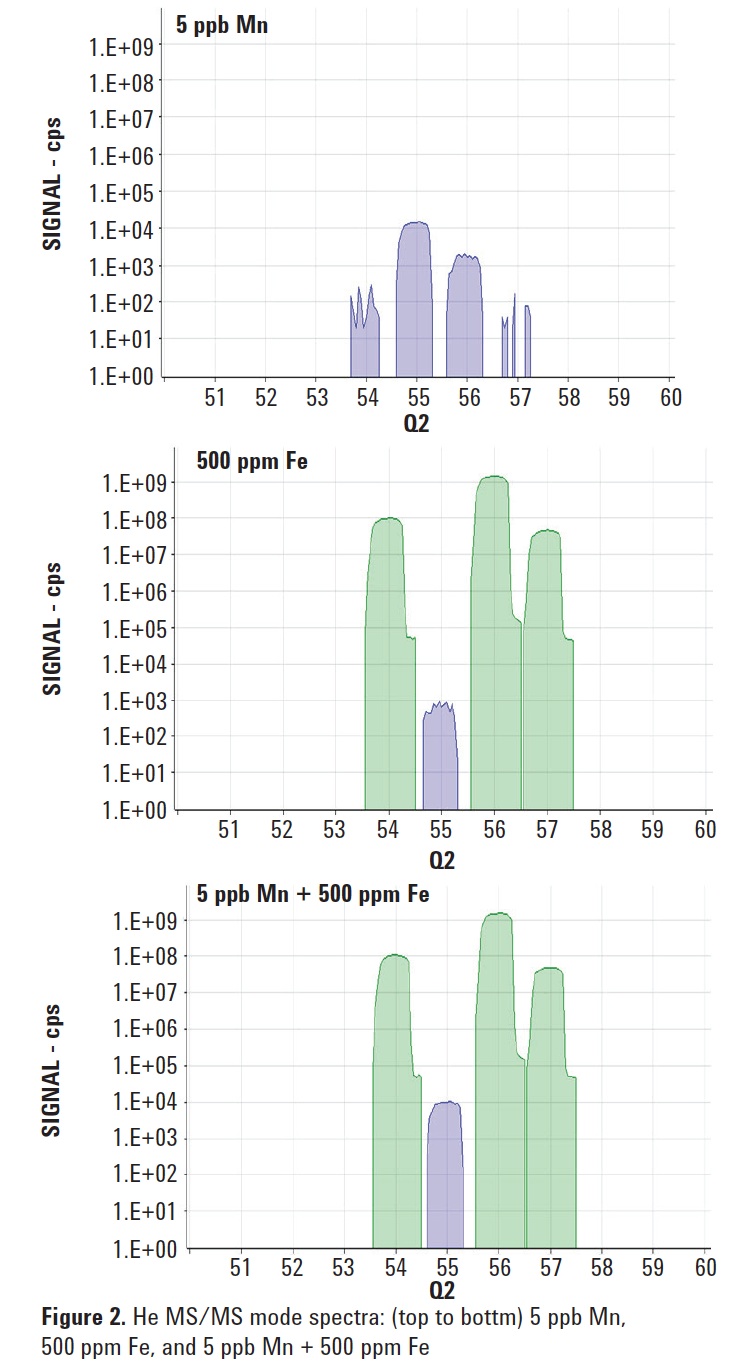
Figure 2 shows three spectra obtained in MS/MS mode with He cell gas. When He cell mode is used for interference removal, precise and accurate analysis is easily achieved. In He MS/MS mode, all interferences (arising from signal overlap from tailing of adjacent peaks and polyatomic ions isobaric interferences) are removed, yielding unbiased analysis and accurate results.
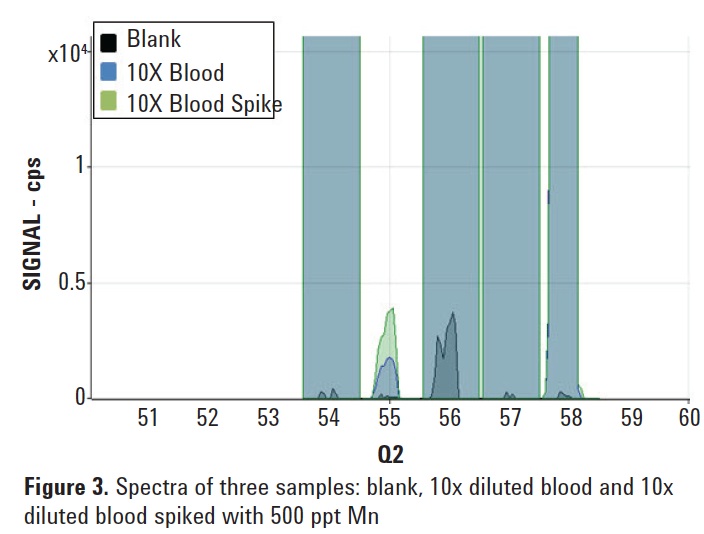
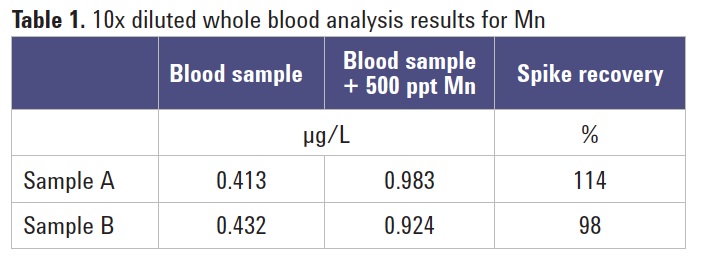
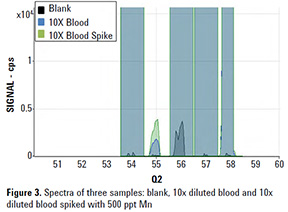
Figure 3 is an overlay of three spectra measured using He MS/MS mode; 1) Blank, 2) 10x whole blood, and 3) 500 ppt Mn spike in 10x whole blood. Table 1 summarizes the results of 10x diluted whole blood analysis and 500 ppt Mn spike recovery test. As shown, very low blank levels were achieved, 55Mn was clearly resolved in the spectrum and good spike recoveries were obtained.
Conclusions
Quadrupole ICP-MS has been almost universally accepted for low level analysis of trace analytes in complex matrices. However, many challenging interferences remain unresolved, especially when trace analytes must be measured close to matrix element peaks in complex samples. The Agilent 8800 ICP-QQQ with MS/MS capability has abundance sensitivity better than 10-10, which enables the analysis of trace analytes (such as Mn) in the presence of a high concentration of adjacent elements (such as Fe).