Simultaneous quantitation of peptides and phosphopeptides by CapLC-ICP-QQQ
Silvia Diez Fernández1, Naoki Sugiyama2, Jorge Ruiz Encinar1 and Alfredo Sanz-Medel1
1Department of Physical and Analytical Chemistry, University of Oviedo, Spain, 2Agilent Technologies, Japan
Keywords
proteins, peptides, phosphorus, phosphopeptides, sulfur, S-containing peptides, heteroatom, isotope ratio, pharmaceutical, clinical, drugs, metabolites, environmental, pesticides, nanotechnology, nanoparticles, oxygen mass-shift
Introduction
LC-MS/MS is used for the quantification of target proteins in pharma/biopharma and clinical research. The approach generally relies on the use of synthetic,
isotopically-labeled forms of each target protein and peptide, which are used as internal standards for the specific quantitation of the corresponding target compound. In contrast, the high temperature plasma ionization source used in ICP-MS ensures that elemental response is practically independent of the original form of the compound, which enables non-species-specific (or compound-independent) quantitation of compounds by measuring the signal for an element contained in the target compound. In this way, different proteins and peptides containing the heteroatoms
S and P can be quantified using a single
S- or P-containing compound as a generic standard. Unfortunately, with conventional quadrupole ICP-MS, the DLs for P and S are compromised by their high ionization potential and by multiple polyatomic interferences. The Agilent 8800 ICP-QQQ can effectively remove those interferences using reaction cell chemistry combined with the unique MS/MS mode, achieving excellent DLs for P and S even in organic solvents. This paper demonstrates the advantage of ICP-QQQ for the determination of proteins and peptides by measurement of P and S heteroatoms.
Experimental
Instrumentation: An Agilent 8800 Triple Quadrupole ICP-MS was used with an Agilent 1260 Series low flow capillary LC system. The standard 2.5 mm internal diameter (id) injector torch was replaced with the narrow injector, 1.5 mm id torch (G3280-80080) used for the analysis of volatile organic solvents. The exit of the LC column was interfaced to the ICP-MS via an Agilent capillary LC interface kit (G3680A) featuring a total consumption nebulizer and micro-volume spray chamber. O2 gas (20% O2 in Ar) was supplied to the plasma as an option gas at 0.08 L/min to prevent carbon build-up on the interface cones. Agilent ICP-MS MassHunter chromatographic software was used for integrated control of the LC-ICP-MS system and for data analysis.
CRC conditions: O2 cell gas flow rate at 0.35 mL/min, Octopole bias = -18 V and KED = -6 V.
Acquisition conditions:
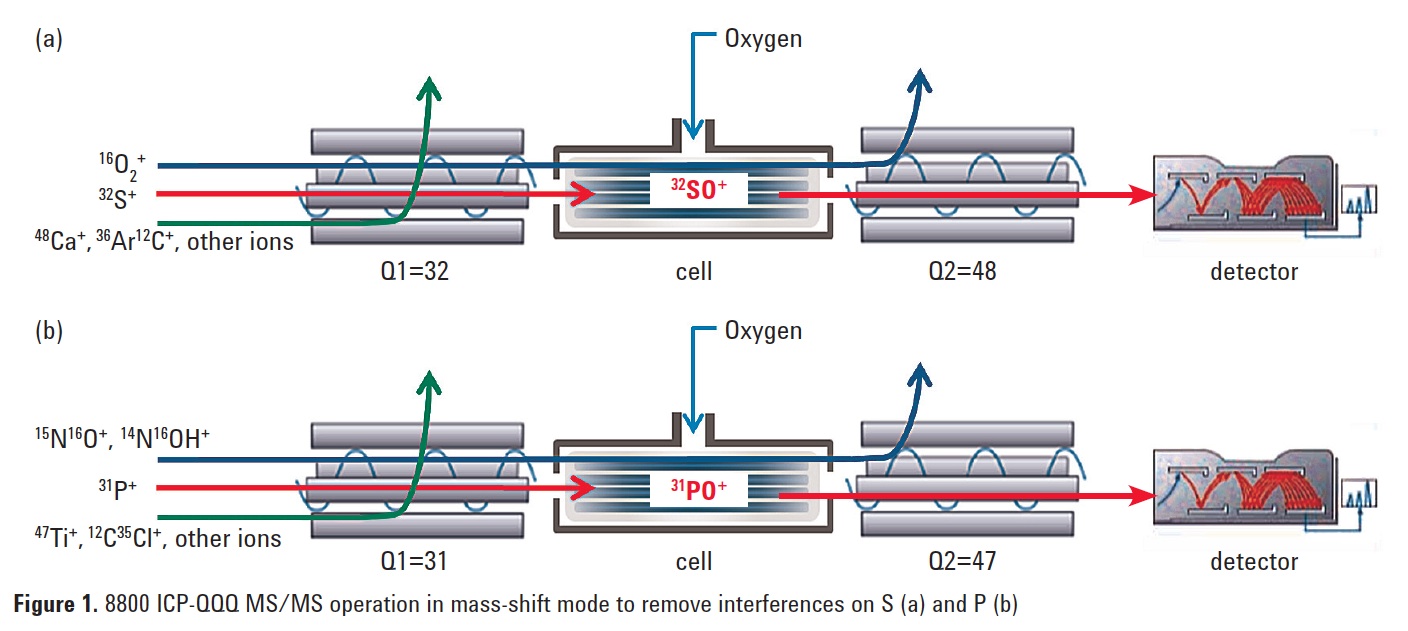
MS/MS O2 mass-shift method was applied for P and S measurement as shown in Figure 1.
LC conditions:
An Agilent Zorbax SB C18
(5 µm, 150 x 0.3 mm) reverse phase column was used with a flow rate of 5 µL/min. Mobile phases of water (A) and acetonitrile (B) were used for a gradient elution with the following profile:
0-3 min: 1% B; 3-35 min: 1-60% B linear. Both mobile phases contained 0.1% formic acid and 10 ppb Ge as ISTD and for tuning. The injection volume was 2 µL.
Reagents: Bis-4-nitro-phenyl phosphate (BNPP, 99% purity) and methionine
(≥ 99% purity) (Sigma- Aldrich, Steinheim, Germany) were used as calibration standards for phosphopeptides and S-containing peptides respectively. Amino acid sequences of the phosphopeptides were LRRA-pS-LG and KRS-pY-EEHIP, and the S-containing peptides were A-C-TPER-M-AE and
VP-M-LK. All peptides were purchased from AnaSpec (Fremont, CA, USA) with
purity ≥95%.
Results and discussion
Calibration and DL
Calibration standards containing
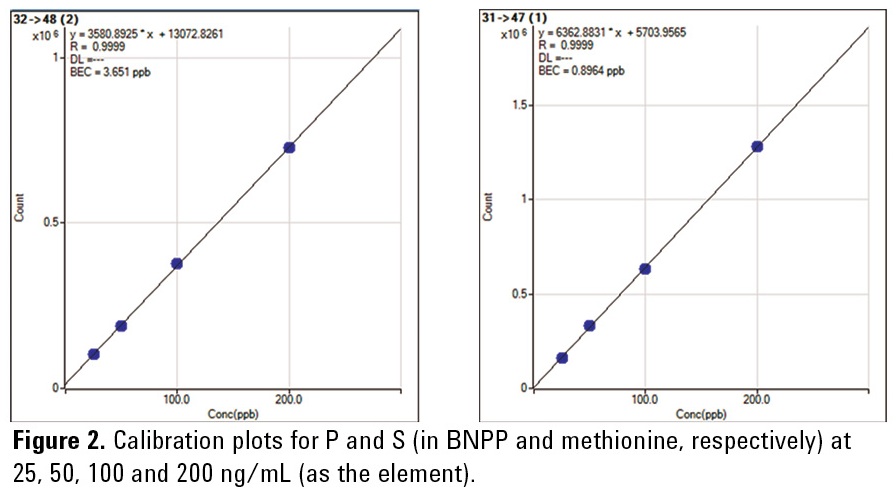
25, 50, 100 and 200 ng/ mL of both P and S (BNPP and methionine, respectively) were injected and measured. Excellent linearity and RSD of <4% was obtained
(see Figure 2).
The chromatogram for the 50 ng/mL standard was used for signal to noise (S/N) and DL calculation. The DL achieved was 0.10 ng/mL for P and 0.18 ng/mL for S. As the injection volume was 2 µL, the DLs in absolute weight were calculated to be 6.6 fmol and 11 fmol for P and S, respectively.
Measurement of phosphopeptide and
S-containing peptides
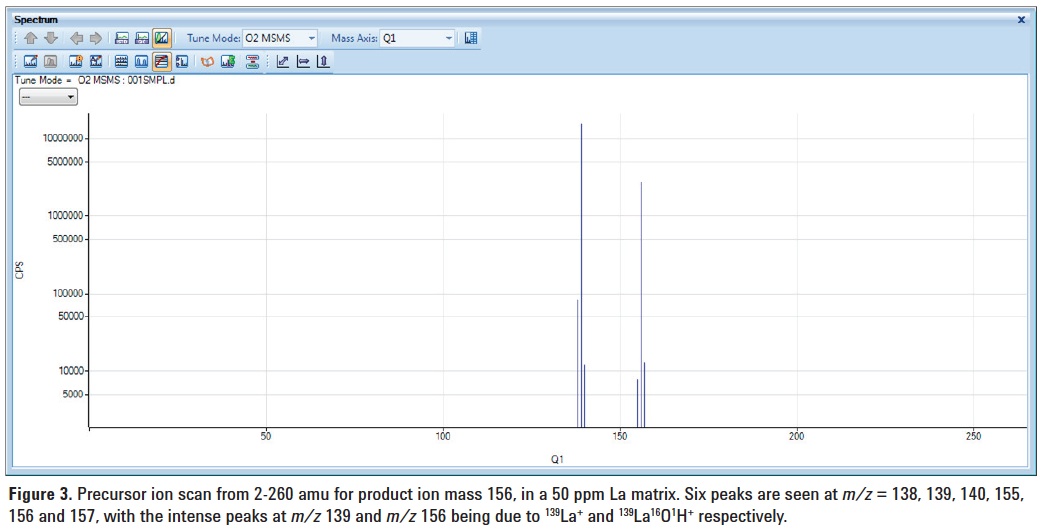
Finally, a sample containing a mixture of phosphopeptides and S-containing peptides was analyzed. The sample was also spiked with the standards methionine and BNPP for non-species-specific calibration. The chromatogram shown in Figure 3 illustrates the excellent peak shape and S/N obtained, demonstrating the exciting potential of ICP‑QQQ for quantitative protein and peptide analysis using measurement of P- and S-heteroatoms.
More information
Simultaneous quantitation of peptides and phosphopeptides by capLC-ICP-MS using the Agilent 8800 Triple Quadrupole ICP-MS, Agilent application note, 5991-1461EN.