Analysis of silicon, phosphorus and sulfur in 20% methanol
Emmett Soffey, Bert Woods
and Steve Wilbur
Agilent Technologies, Japan
Keywords
organic solvents, methanol, silicon, phosphorus, sulfur, hydrogen on-mass, oxygen mass-shift
Introduction
Analysis of organic solvents for trace metals presents a number of challenges to ICP-MS, many of which have been overcome to varying degrees on Agilent’s 7700 Series quadrupole ICP-MS systems. However, even with these advances, several elements remain challenging in organic solvents, particularly silicon, phosphorus and sulfur. All three elements are subject to intense interferences from polyatomic ions based on carbon, nitrogen and oxygen, which are difficult to completely remove using conventional quadrupole ICP-MS (ICP-QMS). Examples include CO+, COH+, N2+ and NO+ on silicon 28, 29 and 30; COH+, NOH+, N2H+, NO+ and CO+ on phosphorus 31 and O2+, NO+, NOH+ and NOH2+ on sulfur 32 and 34. Additionally, phosphorus and sulfur have high first ionization potentials (IP) of 10.5 eV and 10.4 eV respectively, resulting in relatively poor sensitivity compared to more typical elements whose IPs are in the range of ~6 – 8 eV.
Experimental
Instrumentation: Agilent 8800 #200.
Plasma conditions and ion lens tune:
RF power =1550 W,
Sampling depth = 8.0 mm and
CRGS flow rate = 1.05 L/min were used with soft extraction tune, Extract 1 = 0 V and Extract 2 = -190 V.
Ultra pure methanol was spiked with silicon (Si), phosphorus (P) and sulfur (S) at 1, 5, 10 and 50 ppb and measured using the ICP-QQQ in several operational modes in order to evaluate the optimum conditions for the simultaneous analysis of all three analytes. Hydrogen and oxygen reaction gases were evaluated, with H2 cell gas used in both Single Quad (SQ) and MS/MS modes. In addition, helium collision gas was investigated in both SQ and MS/MS mode to determine the effects of using MS/MS with a non-reactive cell gas.
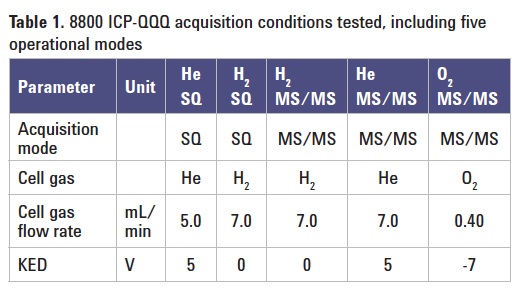
The CRC conditions are outlined in Table 1, which includes the five analysis modes evaluated. Two Single Quad modes were tested, using both He and H2 in the cell, to simulate the capability of a single quadrupole ICP-MS. In addition, three conditions using MS/MS mode were tested using H2, He and O2 as cell gases.
Results and discussion
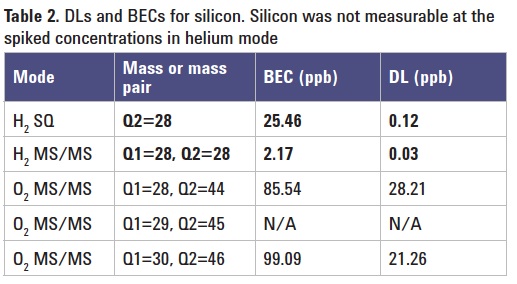
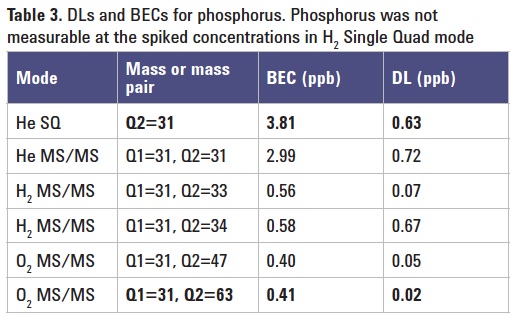
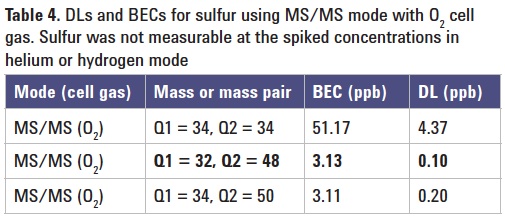
The BECs and DLs results are summarized in Tables 2, 3 and 4, for silicon, phosphorus and sulfur respectively, for all 5 analysis modes tested. SQ and optimum MS/MS results are in bold type for comparison. A few mass-pairs were measured in each mode as shown. For example, Table 2 shows silicon monitored in MS/MS mode with O2 cell gas, using a mass-pair of
Q1 = 28 and Q2 = 44. With Q1 set
to m/z 28, only silicon 28 and any on-mass interferences are allowed to enter the ORS cell. The silicon 28 in the cell reacts with the oxygen cell gas to form SiO+, and Q2 is set to measure at Q1 + 16 (m/z = 44), ensuring that only the M + 16O reaction transition is measured.
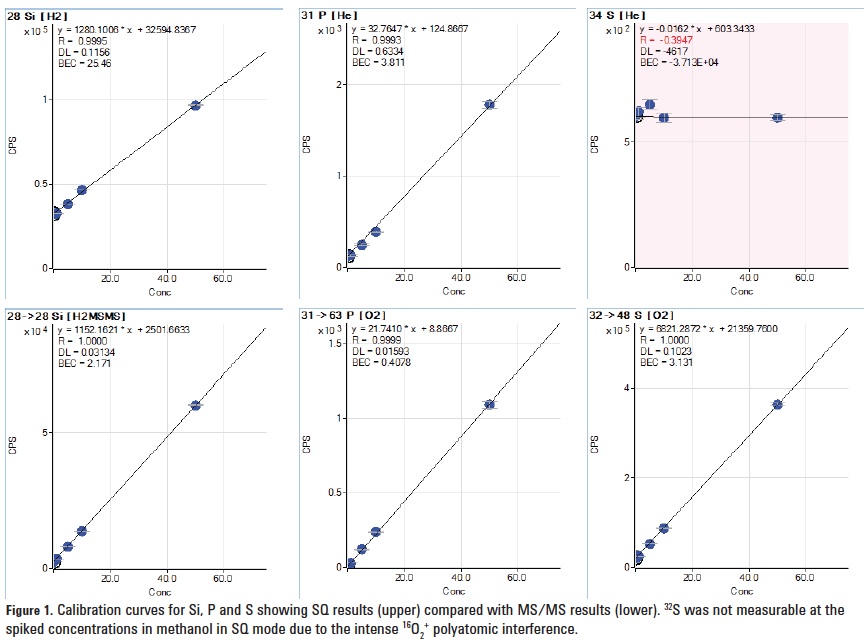
Sample calibration plots are displayed in Figure 1. They are displayed in pairs showing the results obtained using SQ mode with a typical cell gas (upper calibration), compared to MS/MS mode using the optimum conditions (lower calibration).
Conclusions
It can be seen that in all cases the use of MS/MS mode significantly improves both the BEC and instrument detection limit when compared to Single Quad mode. The most notable improvement was for sulfur which cannot be measured at the spiked concentrations (1, 5, 10, 50 ppb) in SQ He mode due to the intense polyatomic background resulting from the methanol matrix. By contrast, on the 8800 ICP-QQQ using MS/MS mode with O2 mass-shift, S can be measured with a DL of 0.1 ppb.
More information
Analysis of silicon, phosphorus and sulfur in 20% methanol using the Agilent 8800 Triple Quadrupole ICP-MS, Agilent application note, 5991-0320EN.