FEASIBILITY STUDY ON THE ANALYSIS OF RADIOISOTOPES: Sr-90 AND Cs-137
Yasuyuki Shikamori and Kazumi Nakano
Agilent Technologies, Japan
Keywords
radioisotopes, radioactive, environmental, nuclear, strontium, 90Sr, zirconium, cesium, 137Cs, barium, abundance sensitivity, oxygen and hydrogen on-mass, nitrous oxide on-mass
Introduction
ICP-MS can be an effective analytical tool for the analysis of long half-life radioisotopes due to its high sensitivity, speed of analysis, low sample consumption, and ease of sample preparation. The challenge for ICP‑MS analysis of radioisotopes arises from interferences; not only by polyatomic ions but also atomic isobar ions that cannot be separated even by high-resolution
(HR-) ICP-MS.
Trace analysis of the radionuclide 90Sr
(half-life = 28.74 years) in environmental samples is of great interest. 90Sr is a main fission product that may be present in the environment following accidental releases from nuclear power plants. Geiger-Muller (GM) detectors or Liquid Scintillation Counters (LSC) are used to measure 90Sr, though both techniques require complex chemical separation prior to analysis, or long integration times. ICP-MS is also used to measure 90Sr, especially when a quick turn-around time is desired. However detection limits of quadrupole ICP-MS are compromised by a spectral overlap from 90Zr; in common with all direct isobaric interferences, the 90Zr overlap is too close in mass to the 90Sr to be resolved using sector field HR‑ICP‑MS, which is limited to a maximum resolution (M/ΔM) of 10,000. This note describes a method for measuring trace 90Sr in the presence of 90Zr using ICP‑QQQ in MS/MS reaction mode. Since it isn't possible to obtain 90Sr, a natural isotope of strontium (88Sr) was used to estimate the DL for 90Sr. A similar approach was applied to 137Cs (half-life = 30.0 years).
Experimental
Instrumentation: Agilent 8800 #100.
Plasma conditions: Preset plasma/Low matrix.
Ion lens tune: Soft extraction tune:
Extract 1 = 0 V, Extract 2 = -190 V.
CRC and acquisition conditions: The following conditions were used for the analysis of 90Sr and 137Cs:
- For 90Sr: MS/MS on-mass mode
(Q1 = Q2 = 90) with O2 + H2 cell gas:
1 mL/min of O2 and 10 mL/min of H2,
Octopole bias = -5 V and
KED = -13 V.
- For 137Cs: MS/MS on-mass mode
(Q1 = Q2 = 137) with N2O cell gas:
7 mL/min of N2O (10% N2O balanced in He, introduced via the 3rd cell gas flow line), Octopole bias = -5 V and KED = -13 V.
Results and discussion
Radioactive Sr-90
(O2 + H2 on-mass mode)
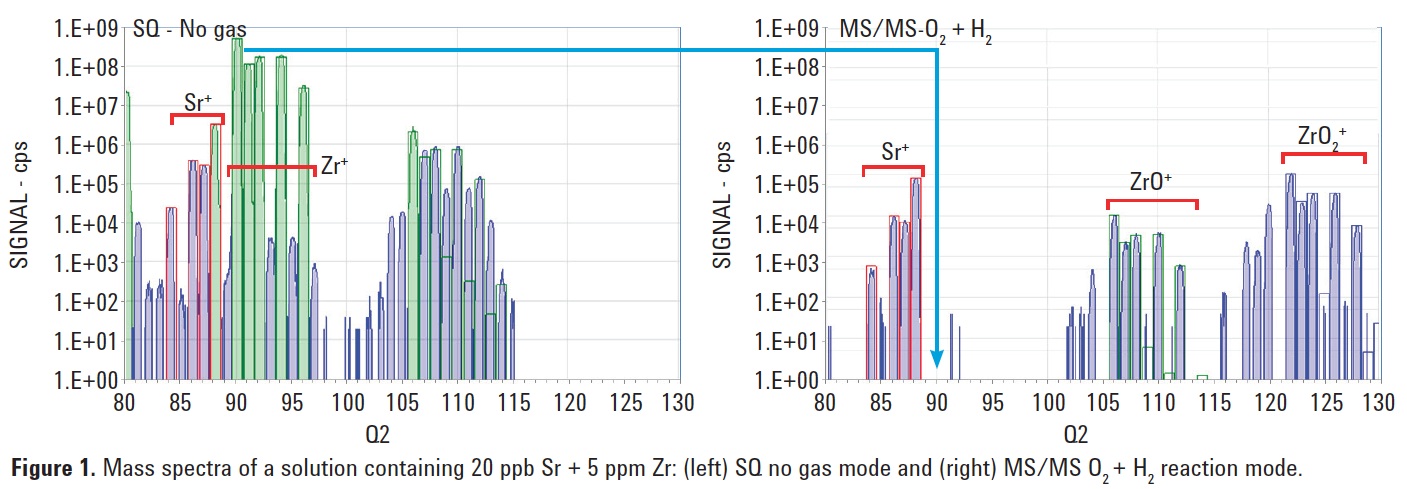
Figure 1 shows spectra of a solution containing Sr and Zr (natural isotopes) acquired on the 8800 ICP-QQQ operated in Single Quad mode (Q1 operated as an ion guide to emulate conventional quadrupole ICP-MS) with no cell gas (left), and in MS/MS mode with O2 + H2 cell gas (right). As can be seen in the left hand spectrum, the overlap of 90Zr+ on 90Sr+ precludes the low-level determination of 90Sr by conventional quadrupole ICP‑MS. The spectrum on the right indicates that 90Sr+ could be measured on-mass at
m/z = 90 free from interference by 90Zr+, since Zr+ reacts readily with the O2 + H2 gas to form ZrO+ and ZrO2+. The
signal-to-noise ratio for 90Sr was improved by six orders of magnitude using
MS/MS O2 + H2 reaction cell mode.
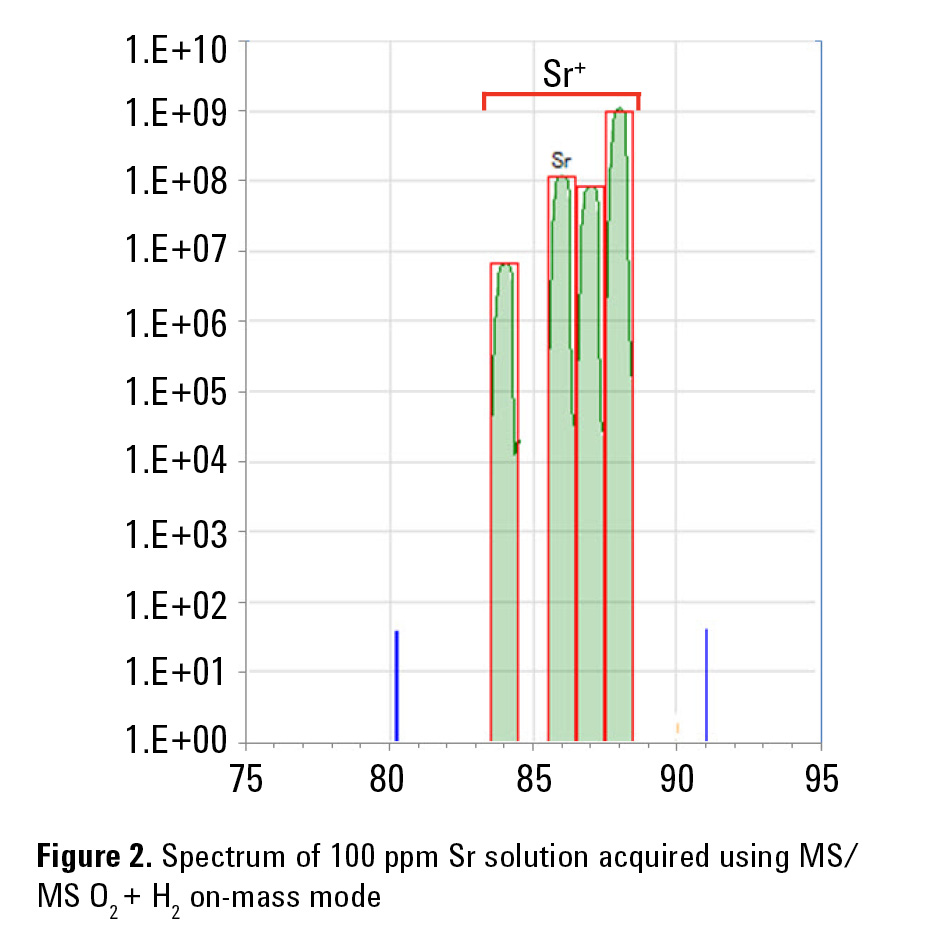
Figure 2 is a spectrum of 100 ppm Sr acquired using MS/MS on-mass mode with O2 + H2 reaction gas. The excellent abundance sensitivity (peak separation) of MS/MS mode can be confirmed. The peak sides reach the baseline with no tailing from the intense peak of the natural isotope of 88Sr+. In addition, no 88SrHH+ at m/ z = 90 is formed in cell, even in a solution containing 100 ppm natural Sr.
Radioactive Cs-137 (N2O on-mass mode)
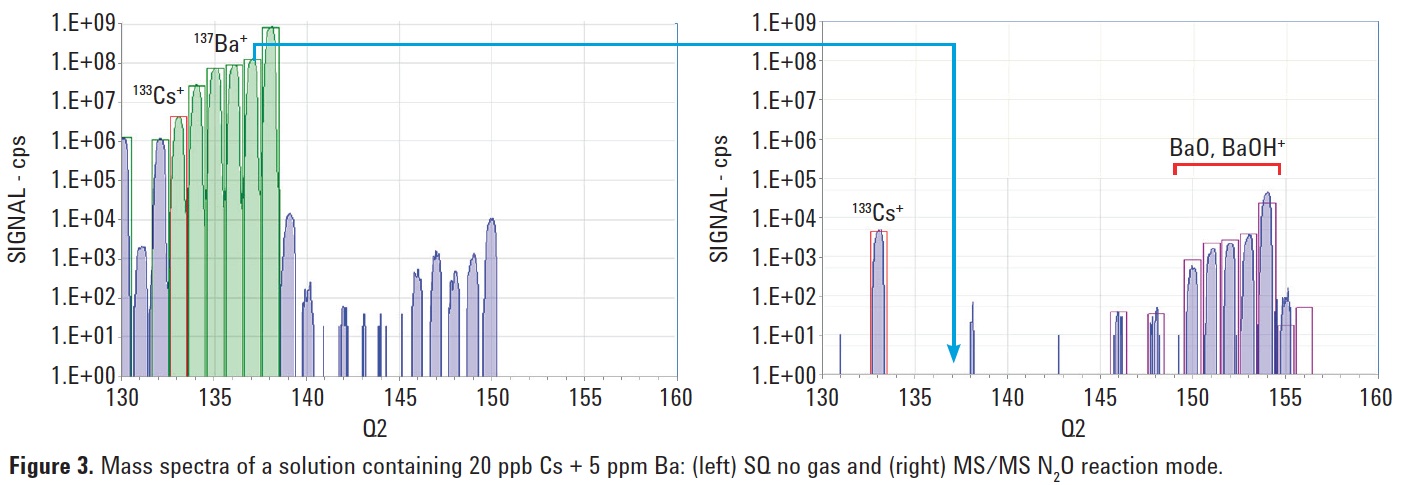
Figure 3 shows spectra of a solution containing Cs and Ba (natural isotopes) acquired on the 8800 ICP-QQQ operated in Single Quad mode with no gas mode (left), and in MS/MS mode with N2O cell gas (right). As can be seen in the left hand spectrum, the 137Ba+ overlap on 137Cs+ is a problem in conventional quadrupole ICP‑MS. As with 90Sr, the right hand spectrum shows that 137Cs+ could be measured on mass at m/z = 137, free from the 137Ba+ interference. Ba+ reacts readily with N2O to form BaO+ and BaOH+ while a part of the Cs+ analyte ion signal remains at its original mass (as shown by the substantial peak for 133Cs in the right-hand spectrum).
Estimated BEC and DL for Sr-90 and Cs-137
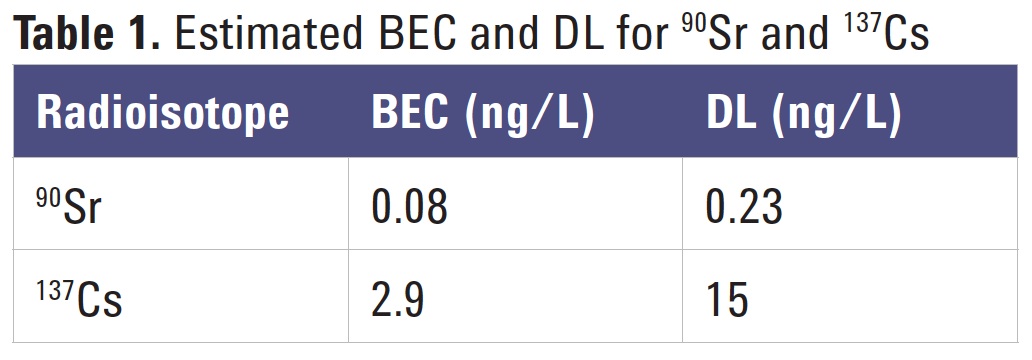
The BEC and DL for two radioisotopes,
90Sr and 137Cs, were estimated from these spectra as summarized in Table 1. This feasibility study demonstrates the potential of ICP-QQQ for the measurement of radioisotopes such as 90Sr and 137Cs.