SAMHSA-Compliant LC/MS/MS Analysis of Amphetamines in Urine with Agilent Bond Elut Plexa PCX and Agilent Poroshell 120
Irina Dioumaeva, John M. Hughes
Agilent Technologies, Inc.
Application Note
Forensic Toxicology
Abstract
New guidelines from the US Substance Abuse and Mental Health Services Administration (SAMHSA), effective October 2010, allowed LC/MS/MS methods to be used for confirmation of initial drug tests [1]. LC/MS/MS methods are often less complicated than previously employed GC/MS methods because they do not typically require a derivatization step. We present a method for analysis of five amphetamines that meets the most recent SAMHSA guidelines to demonstrate linearity, limit of detection (LOD), accuracy, and precision, as well as measurement of matrix effects, extraction recovery, and overall process efficiency. This is one of a suite of six simplified methods covering all classes of SAMHSA-regulated drugs and using premier Agilent products, including Agilent Bond Elut Plexa PCX mixed-mode polymeric SPE sorbent, Agilent Poroshell 120 EC-C18 2.7 µm superficially porous LC column, Agilent 1200 Infinity LC system, and Agilent 6460 Triple Quadrupole LC/MS system with Agilent Jet Stream Technology (AJST) enhanced electrospray source.
Introduction
Amphetamines are psychostimulant drugs included in a group of sympathomimetic amines that mimic the effects of the endogenous neurotransmitters, such as epinephrine (adrenaline), norepinephrine (noradrenaline), and dopamine. Amphetamines are found in the leaves ofEphedra sinica (for example ephedrine) and were first produced synthetically at the end of the 19th century. Their chemical structure features a phenethylamine backbone with a methyl group attached to the alpha carbon, along with other substitutions (Figure 1). A significant portion of amphetamines is excreted intact in urine. By demethylation, more complicated amphetamine derivatives are metabolized into simpler structures, for example methamphetamine to amphetamine, and MDMA to MDA [2]. The 2011 SAMHSA guidelines require screening for and confirmation of five amphetamines – amphetamine, methamphetamine, MDA, MDMA, and MDEA. The confirmation method should demonstrate the ability to distinguish these drugs from structurally similar compounds that are potential interferences, including ephedrine, pseudoephedrine, phentermine, and phenylpropanolamine (PPA, or norephedrine).
In GC/MS methods traditionally employed for detection of amphetamines, it was common to apply periodate pretreatment to oxidize the hydroxyphenethylamines ephedrine and pseudoephedrine and, thus, exclude a chance of interference by these compounds. We eliminated this step, offering instead a reliable chromatographic separation of all analytes of interest required by the latest SAMHSA guidelines.
The new SAMHSA confirmation cutoff concentration for all amphetamines is
250 ng/mL and a limit of detection at 10% of the cutoff concentration is 25 ng/mL [1]. Because high concentrations of amphetamines can be expected in some urine samples, we chose to use a higher capacity 3 mm id Agilent Poroshell 120 column instead of a 2 mm id column for all Agilent SAMHSA methods. With superficially porous 2.7 µm particles, Poroshell 120 provides similar efficiency to sub‑2 µm UHPLC columns but with about 40% less back pressure. Therefore, it allows users of even 400 bar LC systems to increase resolution and to shorten both analysis and re‑equilibration times by applying a higher flow rate.
The simple extraction method described here provides reproducible high recoveries of amphetamines due to the unique properties of Agilent Bond Elut Plexa. Unlike other polymeric sorbents, Plexa possesses amide-free hydroxylated particle surface that excludes protein binding. This results in minimized ion suppression and maximum sensitivity. Fast flow and reproducible performance are due to the narrow particle size distribution with no fines to cause blockages.
With a low sample injection volume of 2 µL and no sample preconcentration, the presented method demonstrates excellent signal-to-noise (S/N) ratios (> 400:1 at
25 ng/mL, 10% of the SAMHSA confirmation cutoff) due to the enhanced sensitivity of the Agilent 6460 Triple Quadrupole LC/MS system with the AJST electrospray source.
Previous methods from Agilent used the Agilent 6410 Triple Quadrupole LC/MS system system and other SPE/LC products and procedures [3,4].
Experimental
Analytes
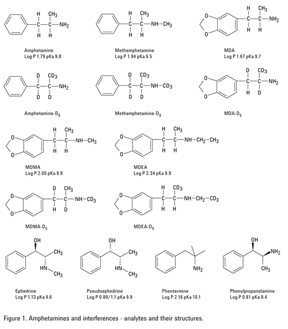
Drug standards were purchased from Cerilliant Corporation as 1 mg/mL (amphetamine, methamphetamine, MDA, MDMA, MDEA, ephedrine, pseudoephedrine, phentermine, and phenylpropanolamine) and 100 µg/mL (amphetamine-D6, methamphetamine-D9, MDA-D5, MDMA-D5, and MDEA-D6)
solutions in methanol.
Materials and instrumentation
SPE
- Agilent Bond Elut Plexa PCX cartridges, 30 mg, 3 mL
(p/n 12108303) - Agilent vacuum manifold VacElut 20 (p/n 12234100)
- Agilent stopcock valves
(p/n 12234520) - Agilent 2 mL autosampler vials
(p/n 5182-0716) - Agilent screw caps for autosampler vials (p/n 5182-0717)
LC
- Agilent Poroshell 120 EC-C18,
3 × 50 mm, 2.7 µm (p/n 699975-302) - Agilent 1260 Infinity LC (G1379B microdegasser, 1312B binary pump in low delay volume configuration, G1367E autosampler, and G1330B thermostat)
MS
- Agilent 6460A Triple Quadrupole LC/MS system with AJS electrospray ionization source.
Sample preparation
Pretreatment
Spike 0.5 mL of urine with ISTDs at
500 ng/mL each; use of 12 × 75 mm glass tubes is recommended. Add 1 mL of 2% formic acid, vortex; centrifuge if cloudy.
Extraction
- Condition Bond Elut Plexa PCX column with 0.5 mL methanol – soak, then let drip.
- Load sample/supernatants.
- Wash 1: 1 mL 2% formic acid.
- Wash 2: 1 mL of methanol.
- Dry 5–10 minutes under vacuum
(10–15 in Hg). - Elute with 1 mL ethyl acetate: methanol: ammonium hydroxide (50:50:20), freshly prepared. Let eluate drip into collection vials, then apply low vacuum (2–3 in Hg).
- Evaporate under stream of nitrogen to 0.2 mL at ≤ 37 °C.
- Add 100 µL of 0.025 N hydrochloric acid in methanol, vortex.
- Evaporate to dryness.
- Reconstitute in 0.5 mL initial mobile phase (15% methanol, 85% water, 0.1% formic acid).
LC/MS/MS
LC conditions
Mobile phase A
0.1% formic acid in water
Mobile phase B
0.1% formic acid in methanol
Flow rate
0.8 mL/min
Gradient
Time (min) % B
0.0 15
1.5 15
3.5 30
3.6 90
6.6 90
6.7 15
Stop time
6.8 min
Post time
2 min
Max pump pressure
400 bar
Injection volume
2 µL
Injection with needle wash
Needle wash
Flush port 75:25 methanol:water for 10 s
Disable overlapped injection
No automatic delay volume reduction
MS conditions
ES Source Parameters
Ionization mode
Positive
Capillary voltage
4,000 V
Drying gas flow
10 L/min
Drying gas temperature
350 °C
Nebulizer gas
35 psi
Sheath gas flow
12 L/min
Sheath gas temperature
400 °C
Nozzle voltage
0 V
MS parameters
Scan type
MRM
Pre-run script
SCP_MSDiverterValveToWaste()
{MH_Acq_Scripts.exe}
Time segments
#1: 0.6 min (for interferences separation) or 1.2 min (for five amphetamines only) - diverter valve to MS
Delta EMV (+)
200 V
Results and Discussion
At acidic pH, the amine group of amphetamines was protonated, and the analytes were efficiently retained on Bond Elut Plexa PCX polymeric sorbent by a combination of hydrophobic interaction and a strong cation exchange.
A 100% methanol wash eliminated most matrix interferences without the loss of analytes from the sorbent. A strong base was added to organic eluent to break ionic interaction between the amphetamines and strong cation exchange sorbent. The recovery was optimized with two-component organic eluent consisting of 50% ethyl acetate and 50% methanol, with 20% NH4OH added shortly before sample elution.
Amphetamines are rather volatile and could evaporate at the solvent evaporation step of sample preparation unless precipitated as salts by addition of the hydrochloric acid. It is best to add HCl toward the end of evaporation to avoid the formation of ammonium chloride salts which will cause ion suppression.
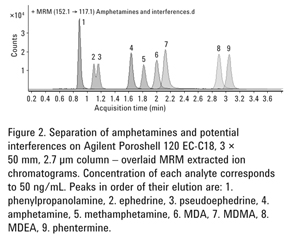
Figure 2 shows excellent separation of five amphetamines and potential interferences specified by SAMHSA on the Poroshell 120 EC-C18, 3 × 50 mm, 2.7 µm column, which was completed within 3.2 minutes. LC separation started with a low fraction of organic solvent (15%) to allow salts and other polar components of urine to elute at the beginning of the sample run. Each sample run started with diverting the first portion of flow to waste to minimize source contamination. Data collection started immediately after the diverter valve switch. A flow rate of 0.8 mL/min allowed short separation and re-equilibration times.
A dynamic MRM method using retention time and delta RT (time window) for a certain transition is recommended for the analysis of several compounds. When good separation from interferences is ensured, and data collection is focused on five amphetamines only, the valve can be switched from waste to mass spectrometer at 1.2 minutes instead of 0.6 minutes (time segment no. 1 in the MS method).
SAMHSA guidelines require the use of one quantifier and at least one qualifier ion for both target compound and ISTD. A third transition for target analytes (Table 1) was provided where possible for additional confidence. Agilent MassHunter Quantitative software calculated qualifier ion ratios, automatically highlighting those out of acceptable range.
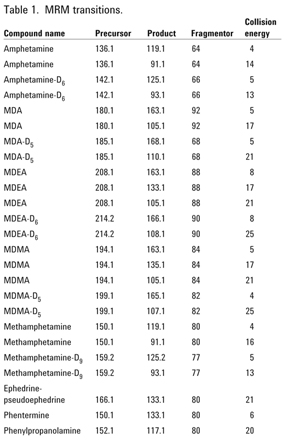
S/N ratios exceeding 400:1 were obtained for quantifier peaks of all five amphetamines at 25 ng/mL (Figure 3, upper panel: S/N is shown for the MDEA quantifier peak). This illustrated the state-of-the-art performance of the Agilent 6460 Triple Quadrupole LC/MS/MS capable of reliably detecting all five amphetamines at a small fraction of the SAMHSA cutoff.
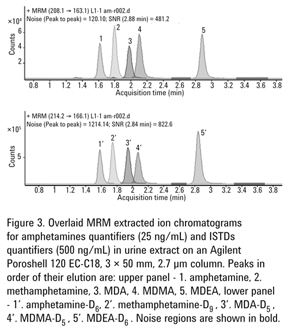
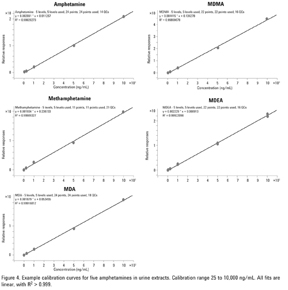
Figure 4 gives examples of calibration curves for extracted urine standards at five concentration levels. Calibration standards were prepared by spiking negative urine at 25, 250, 1,000, 5,000, and 10,000 ng/mL with each of the five members of the amphetamines class. Deuterated internal standards for each analyte were added at 500 ng/mL. The excellent linear fits to all curves with R2 > 0.999 demonstrated linearity of the method across a broad dynamic range of concentrations, as required by SAMHSA guidelines.
Method evaluation
Method performance metrics in Table 2 were calculated according to the principles laid out in Matuszewski et al and widely accepted as an industry standard approach for LC/MS/MS methods [5]. The extraction procedure and LC/MS/MS measurement were performed for five replicates of negative urine spiked pre-extraction with each of the five members of the amphetamines class at the cutoff level, and five replicates of negative urine extract reconstituted in initial mobile phase, and then fortified at 250 ng/mL (spiked post-SPE). The third measurement was of initial mobile phase (the reconstitution solvent) fortified to correspond to the cutoff concentration of 250 ng/mL in urine (spiked mobile phase).
Process efficiency (absolute recovery) is a ratio of a peak area of target analyte in urine sample spiked pre-SPE to its peak area in matrix-free spiked mobile phase. Extraction recovery is a ratio of a peak area of target analyte in urine extract spiked pre-SPE to its peak area in an extracted negative urine sample spiked post-SPE. Matrix effect is a ratio of a peak area of target analyte in urine spiked post-SPE to its peak area in spiked mobile phase. Accuracy is a ratio of a measured concentration calculated using the calibration curve to the expected concentration in a sample spiked with a known amount of target analyte. Precision or coefficient of variation (CV) is a measure of reproducibility and is calculated as a percent standard deviation over the mean of the five measurements.
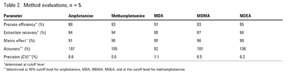
Table 2 shows that the extraction recovery for all five amphetamines was ≥ 94%, with overall process efficiency higher than 90% in four out of five analytes; for amphetamine, process efficiency was 86%. The matrix effect of 91 to 99% means only a 1 to 9% signal reduction due to ion suppression, thus, confirming the exceptional cleanliness of Plexa PCX-processed extracts. High accuracy (within 10% of the target) and excellent precision (CV < 1.1%) is typical for this method.
Conclusions
The solid phase extraction procedure coupled with the LC/MS/MS detection method described here is SAMHSA-compliant and provides accurate, precise, and reproducible results for forensic toxicology or other analytical environments with similar requirements for legally defensible data. A hardware setup is the same as in other 2011 SAMHSA methods from Agilent. These methods are intended for all users of Agilent 1100 and Agilent 1200 Series LC because the back pressure in the LC system does not exceed 400 bar. Source parameters can be easily modified to use this method with other models of Agilent Triple Quadrupole LC/MS systems. Electronic copies of the LC/MS/MS acquisition and quantitation methods are available from Agilent Technologies.
References
- SAMHSA (2010) Manual for Urine Laboratories, National Laboratory Certification Program, 1 October 2010. U. S. Department of Health and Human Services.
- R. Baselt, (2008) Disposition of Toxic Drugs and Chemicals in Man. 8th edition. Atlas Books, Ashland, OH, USA.
- P. Moorman and J. Hughes, (2010) “Amphetamines (expanded) in Urine by LC/Triple Quadrupole Mass Spectrometry (LC/MS/MS)”. SOP, Agilent Technologies, Inc. Publication Number 5990-5865EN.
- J. Hughes, and P. Moorman, (2011) “Confirmation by Triple Quadrupole LC/MS/MS for HHs-compliant Workplace Urine Drug Testing”. Agilent Technologies, Inc. Seminar available from www.agilent.com/chem.
- B. K. Matuszewski, M. L.Constanzer, and C. M. Chavez-Eng, (2003) “Strategies for the assessment of matrix effect in quantitative bioanalytical methods based on HPLC-MS/MS”. Analytical Chemistry, 75: 3019-3030.
For More Information
These data represent typical results. For more information on our products and services, visit our Web site at www.agilent.com/chem.
©Agilent Technologies, Inc., 2013
February 15, 2013
View this Application Note in its entirety: 5990-9623EN