Extraction of Benzodiazepines in Urine with Polymeric SPE Cation Exchange, Agilent Bond Elut Plexa PCX
William Hudson
Agilent Technologies, Inc.
Application Note
Forensic Toxicology
Introduction
Benzodiazepines are a large class of drugs and include compounds such as diazepam (Valium), chlordiazepoxide (Librium), oxazepam (Serax), lorazepam (Ativan), alprazolam (Xanax), clonazepam (Clonopin), and others. 1,4-Benzodiazepines, such as diazepam, nordiazepam, and temazepam, are metabolized and excreted as oxazepam and oxazepam glucuronide. The nitrobenzodiazepines, such as clonazepam and flunitrazepam, are metabolized to a
7-amino metabolite in urine. Flurazepam is rapidly desalkylated.
Quantitative analysis of benzodiazepines in urine by LC/MS can be difficult due to the high level of matrix components. Organic salts as well as pigments and proteins cause ion suppression and the loss of signal intensity. Agilent Bond Elut Plexa PCX SPE products are a member of the Plexa family based on a polymeric cation exchanger. Plexa PCX products use a generic and simplified method to remove neutral and acidic interferences from the matrix and concentrate basic analytes, resulting in improved analytical performance and sensitivity in the quantification of basic compounds.
In addition, Bond Elut Plexa PCX SPE products offer faster and highly reproducible flow rates, resulting in excellent tube-to-tube and well-to-well performance. Bond Elut Plexa PCX SPE products exhibit significantly reduced ion suppression because their highly polar, hydroxylated surfaces are entirely amide free. Therefore, the particle exterior minimizes strong binding of proteins and phospholipids. An LC/MS/MS method is presented for the quantitative determination of benzodiazepines and their target metabolites in human urine specimens with Bond Elut Plexa PCX SPE tubes. Hydrolysis may also be necessary by adding 5,000 units of β-glucuronidase to a
1 M acetic acid (pH = 3.8) buffered urine sample. The sample was vortexed and incubated for 2 hours at 60 °C prior to extraction.
Materials and Methods
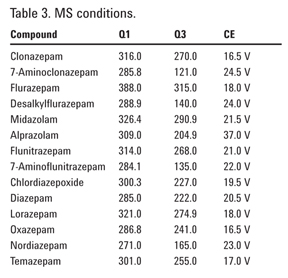
LC conditions
Mobile phase:
A: 0.1% Formic acid
B: Methanol
Gradient:
t = 0-1 minutes 40% A : 60% B
t = 2.0-4.30 minutes 20% A : 80% B
t = 4.31-5.30 minutes 40% A : 60% B
Flow rate:
0.2 mL/min
Column:
Agilent Pursuit XRsUltra 2.8 C18,
2.0 × 100 mm (p/n A7511100X020)
Capillary:
70 V
Dry gas temperature:
350 °C, 30 psi
CID:
Argon
Polarity:
Negative
Results and Discussion
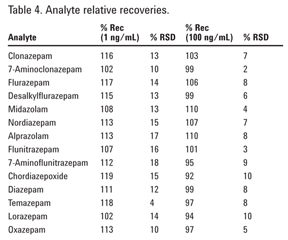
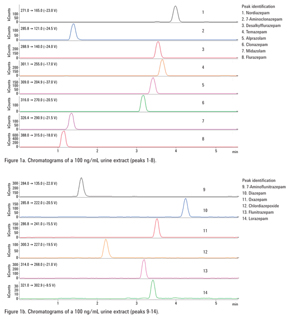
The procedure describes a method for extracting and determining 14 different benzodiazepines in human urine. The limit of detection (LOD) of the combined solid phase extraction and LC/MS/MS analysis was 1.0 ng/mL. Recoveries were calculated from a first order regression with RSD values based on a sampling of n = 6. Excellent absolute recoveries were achieved demonstrating good retention and elution, as well as minimal ion suppression. Response for all the compounds evaluated was linear up to three orders of magnitude from 1.0 ng/mL to 1.0 µg/mL with correlation coefficients all above 0.995. To demonstrate reproducibility, samples were analyzed at two concentrations (n = 6). Table 4 shows that the extractions produced very reproducibly high recoveries.
Conclusions
Agilent Bond Elut Plexa PCX is a useful tool for high throughput SPE applications, which require analysis at low analyte levels, need validated reproducibility, and must be quickly implemented with minimal method development. Bond Elut Plexa PCX products meet these requirements.
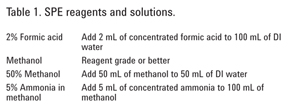
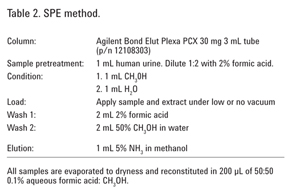
With Bond Elut Plexa PCX, a generic drug extraction protocol can be applied to polar analytes with basic amino functional groups. Under acidic conditions, the charged analyte binds to the cation exchange groups of the sorbent. Polar interferences and proteins are washed away with an acidic, aqueous solution. A wash with 50% aqueous methanol is possible without a significant loss of analytes. The wash elutes neutral compounds retained in the hydrophobic cores of the sorbent. Finally, ammoniated methanol was used to disrupt the cation exchange interaction, resulting in the elution of the benzodiazepines.
Flow rate is fast because Bond Elut Plexa PCX particles have much narrower particle size distribution with no fines to cause blockages, thus resulting in excellent tube-to-tube reproducibility. Bond Elut Plexa PCX tubes are, therefore, a useful tool for high throughput SPE applications, which require analysis at low analyte levels, validated reproducibility and quick implementation, with minimal method development.
©Agilent Technologies, Inc., 2013
February 19, 2013
View this Application Note in its entirety: SI-01334