Extraction of Non-Polar Basic Drugs from Plasma with Polymeric SPE Cation Exchange, Bond Elut Plexa PCX
William Hudson and
Andrea Junker-Buchheit
Agilent Technologies, Inc.
Application Note
BioPharma
Introduction
Bioanalytical methods for pharmaceutical analysis require quick and easy method development and validation to reduce bottlenecks in drug development. Biological samples can be complicated to analyze due to proteins, peptides, salts, phospholipids and other endogenous compounds. Sample clean-up is necessary to remove these inferences without significant loss of the target analytes. Solid phase extraction utilizing simplified methodologies for routine analysis is the technique of choice.
Agilent Bond Elut Plexa PCX is a new addition to the Plexa family and uses a polymer cation exchange technique. Plexa PCX utilizes a generic and simplified method to remove neutral and acidic interferences from the matrix and concentrate basic analytes, resulting in improved analytical performance and sensitivity in the quantitation of basic compounds. In addition, faster and highly reproducible flow rates are the norm, resulting in excellent tube-to-tube and well-to-well performance. Plexa PCX significantly reduces ion suppression because its highly polar, hydroxylated surface is entirely amide-free. The particle exterior excludes proteins and avoids strong binding of phospholipids. Thus, efficient removal of phospholipids from plasma is ensured. A simple generic method was developed for the extraction and analysis of non-polar basic compounds in human plasma.
Materials and Methods
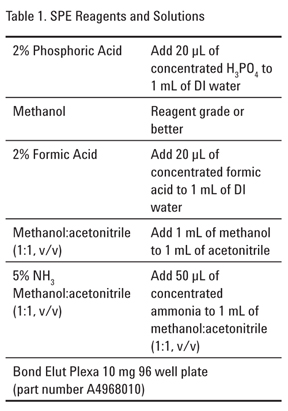
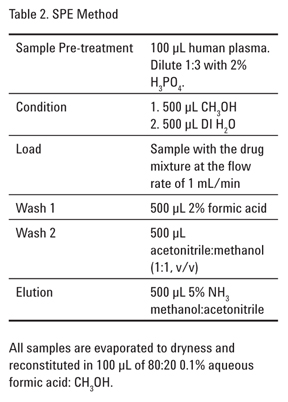
Results and Discussion
LC Conditions
Mobile Phase:
A: 0.1% Formic acid
B: Methanol
Gradient:
t = 0 min 80% A : 20% B
t = 0-2 min 20% A : 80% B
t = 3.5-5 min 80% A : 20% B
Column:
Agilent Pursuit C18, 2.0 × 50 mm, 3 µm
(p/n A3051050X020)
MS Conditions
Transition ions and collision energy were:
Compound
Q1
Q3
CE
Ranitidine
315.0
176.0
-21.0V
Propranolol
260.1
116.0
-17.5V
Amitriptyline
278.1
233.0
-17.0V
Loratadine
383.1
337.0
-31.0V
Capillary = 25 V, Dry gas temp = 400 °C, 30 psi, CID = Argon
Polarity: Positive
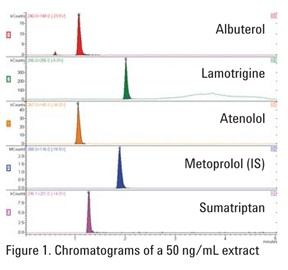
This LC/MS method describes the quantitative determination of non-polar basic compounds in human plasma using Bond Elut Plexa PCX for SPE (Figure 1). The limit of detection (LOD) of the solid phase extraction and LC/MS/MS analysis was
1.0 ng/mL. Recoveries were calculated from a 2nd order regression with RSD values based on a sampling of n = 6. Excellent recoveries were achieved, demonstrating good retention and elution, as well as minimal ion suppression. Response for all the compounds evaluated was linear up to 3 orders of magnitude from 1.0 ng/mL to
1.0 µg/mL with correlation coefficients all above 0.999.
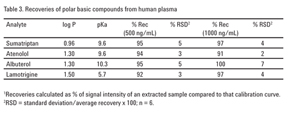
To demonstrate reproducibility, samples were analyzed at two different concentrations (n = 6). As shown in Table 3, reproducibly high recoveries were obtained according to the generic standard protocol.
Conclusions
With Agilent Bond Elut Plexa PCX, it is possible to use a single method for the extraction of non-polar basic analytes from plasma that delivers reproducibly high recoveries. Under acidic conditions, the charged analyte binds to the cation-exchange groups of the sorbent (see Table 3 for pKa). Polar interferences and proteins are washed away with an acidic, aqueous solution. A neutral wash with relatively strong solvents, such as 50% methanol:acetonitrile, is possible without loss of analyte. The wash elutes neutral compounds retained in the hydrophobic cores of the sorbent. Finally, a mixture of organic solvents with ammonia is used to disrupt the cation exchange interaction, resulting in the elution of the basic drugs.
Flow rate over the 96-well plate is fast because Plexa PCX particles have much smaller interstitial paths with no fines to cause blockages, resulting in high well-to-well reproducibility. Automated 96-well technology is convenient which opens new opportunities to maximize efficiency. Bond Elut Plexa PCX is therefore a useful tool for high-throughput SPE applications which require analysis at low analyte levels, need validated reproducibility, and that must be quickly implemented with minimal method development. It is highly recommended for bioanalytical work in pharmaceutical clinical trials, including contract research.
©Agilent Technologies, Inc., 2012
September 6, 2012
View this Application Note in its entirety: SI-01014